
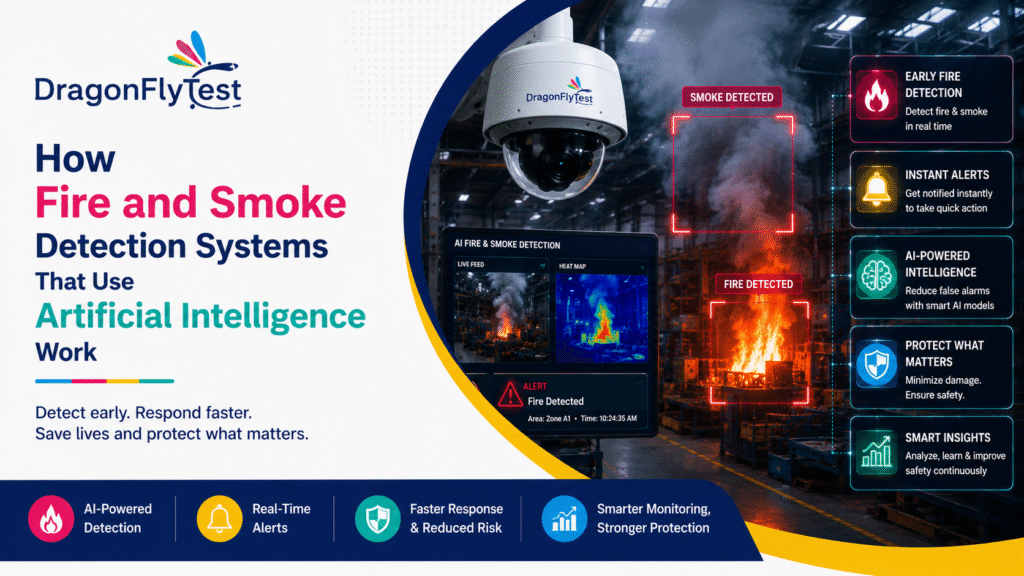
Fire Safety Technology | Computer Vision | Industrial Monitoring
A Fire That Changed How We Think About Detection
In 1987 a fire broke out under the escalators at Kings Cross station in London. The first reports came in after 7 pm. By 7:45 it had turned into a fire that killed 31 people and injured many more. People who worked there had seen something a small fire, some smoke. But they thought it was not a big deal that the existing systems would catch it that there was time. There was not.
What happened at Kings Cross is a bad example of a problem that happens in smaller ways in warehouses, factories, server rooms and commercial kitchens every day. Regular fire detection systems. Heat sensors, smoke alarms, smoke detectors. Are built around thresholds. They wait until smoke gets too thick or temperature gets too high. Then they do something. By the time those thresholds are met a fire has usually been burning for a while.
Artificial Intelligence based AI Fire and Smoke Detection works differently. It does not wait for a threshold. It watches. And that is a difference in a fire situation. It is the difference between minutes and seconds. Which is often the difference between a small incident and a big disaster.
The Big Problem with Waiting for a Threshold to Trip
smoke detectors and heat sensors are good well understood and cheap. There is a reason they’re in almost every building.. Their big limitation is how they work. A smoke detector for example shines a beam of light inside a room and measures when smoke particles block that beam enough to trigger an alarm. That works well for a fire. It works well in the early stages when smoke is thin spread out or rising slowly in a high-ceiling space like an aircraft hangar or a large cold-storage facility.
Heat detectors have an issue. They respond to temperature change. Either a high temperature or a fast rise in temperature.. In outdoor or semi-outdoor environments in cold rooms or in spaces with temperatures that change a lot it is hard to set the right threshold. If you set it too sensitive you get alarms all the time. If you set it too conservative the alarm goes off late.
There is also a problem with how the sensorsre placed. A sensor in a corner of a warehouse only covers a small area. Smoke or heat has to travel to where the sensor is. In a facility by the time enough smoke has spread across the room to trigger a sensor at the far end a lot of time has passed. Time that a camera could have used to flag something minutes earlier.
What Computer Vision Actually Brings to the Problem
Cameras see everything in their field of view all the time without waiting for something to arrive at them. That is the advantage. A camera covering a production floor does not have a detection radius. It has a detection field.. When that camera is connected to an Artificial Intelligence system trained to recognize the early signs of fire and smoke it becomes something very different from a passive recording device.
The field of computer vision has spent a time developing the tools needed to make this work reliably. Special computer programs. The kind that underpin modern image recognition. Can be trained on huge datasets of labeled images to identify objects, patterns and anomalies with accuracy that rivals or exceeds human visual inspection in controlled conditions. Apply that capability to fire and smoke detection. You have a system that can process incoming video frames in milliseconds and flag visual patterns that a human operator would likely miss or dismiss as insignificant.
The practical value is even bigger when you consider that commercial and industrial facilities already have CCTV cameras installed. Deploying Artificial Intelligence based fire detection does not necessarily require hardware. It can layer onto existing cameras via an edge processing device or a cloud-connected software platform. The camera network that was previously just recording footage for review after an incident becomes a real-time early warning system. That is a shift in what the same hardware investment delivers.
Reading Smoke Before It Becomes a Problem: How the Pattern Recognition Works
Smoke is hard to recognize. Its appearance changes based on what’s burning how hot the fire is, what the lighting conditions are and how it interacts with air currents in the space. Early-stage smoke from a fault looks nothing like the thick black smoke from burning rubber or the white wisps from a smoldering cardboard box. A system that only knows what thick grey smoke looks like will miss early-stage events.
Trained Artificial Intelligence models for smoke detection are built on diverse datasets that include smoke from many different sources, filmed in different lighting environments at different distances against different backgrounds. The model learns to identify smoke not as a color or density but as a pattern of characteristics. The way it drifts and spreads how it interacts with light the way it fills a region of the frame the subtle haze it creates at its edges.
One of the interesting aspects is how the models handle the difference between smoke and things that look like smoke. Steam from equipment. Dust clouds in an environment. Morning mist near loading dock doors. Exhaust from a forklift. All of these can look like smoke to a detection algorithm and produce false alarms that erode trust in the system quickly. Modern Artificial Intelligence models trained specifically for this application use analysis. Looking at how the pattern changes across consecutive frames. To distinguish smokes characteristic behavior from these lookalikes. Steam tends to spread and dissipate quickly. Dust clouds settle. Smoke. Persists. The model learns to tell them.
This multi-frame analysis is what gives Artificial Intelligence based detection its edge over single-point sensors. A smoke detector can only measure what is physically at its location now. The Artificial Intelligence model is watching how something is changing across an area over time. Which is how a trained human spotter would assess a potential fire situation.
Flame Detection: Catching What Smoke Alone Misses
Not every fire produces smoke before it produces visible flame. Accelerating fires fed by highly combustible materials. Fuel spills, certain chemical reactions, paper in a dry storage environment. Can go from ignition to open flame very quickly with relatively little smoke in the early moments. For those scenarios flame detection is the relevant capability.
Visual flame detection from camera feeds is a technical challenge from smoke detection. Flame has a color range. Oranges, yellows, reds. But so does a sunset through a window certain types of industrial lighting and the glow of heated metal in a foundry. Color alone is not enough as a detection criterion.
The Artificial Intelligence approach to flame detection uses a combination of color analysis, flicker frequency analysis and shape recognition. Flames flicker within a frequency range. Typically between 3 and 30 Hz depending on the size and intensity of the fire. They also have irregular edges and a dynamic form that changes shape continuously in a way that distinguishes them from static bright objects or steady light sources. The Artificial Intelligence model analyzes all of these characteristics together looking for regions in the frame where they co-occur persistently across multiple frames.
In industrial settings flame detection models are also trained to handle partial occlusion. A fire that is partially hidden behind equipment or visible through a mesh barrier or reflected in a surface rather than viewed directly. These edge cases represent a portion of real-world detection scenarios and a model that only recognizes clean fully visible flames in optimal lighting will underperform in actual deployment environments.
Using Existing CCTV Infrastructure: What That Actually Involves
The idea that Artificial Intelligence fire detection can run on existing cameras is true. It comes with some nuances worth understanding. Camera placement that was designed for security monitoring. Aimed at entry points valuable assets or personnel movement. Is not always optimal for fire and smoke detection. Security cameras tend to be positioned at head height or slightly above angled to capture faces and activity. Smoke rises. Flame can originate at floor level. Some repositioning or supplementary camera placement in high-risk zones often improves detection performance meaningfully.
Resolution and frame rate also matter. Lower-resolution cameras can still support Artificial Intelligence detection. They reduce the models ability to identify early-stage low-density smoke at distance. Most modern IP cameras above a resolution threshold perform adequately but legacy analog systems with lower image quality may limit sensitivity. This does not mean the approach is not viable with cameras. It means the systems detection range and early-warning window will be different and that should be understood going in.
Lighting conditions in the monitored space are another variable. Artificial Intelligence models trained on datasets handle variable lighting better than earlier generation systems but very low-light environments. Poorly lit storage areas, sites that operate in partial darkness. Can reduce accuracy. Some deployments supplement with lighting in critical zones specifically to address this. Thermal imaging cameras while more expensive can also be integrated into the Artificial Intelligence platform and provide detection capability that is entirely independent of visible light conditions.
What makes the CCTV-integration approach compelling despite these nuances is the coverage density it enables. A facility with 40 cameras distributed across its floor plan has 40 visual vantage points feeding into the detection system simultaneously. No sensor-based network provides that kind of coverage at comparable cost. The tradeoff is managing the image quality and placement variables.. That is an engineering problem, with known solutions, not a fundamental limitation.
Speed Is the Point: The Numbers Make That Clear
The reason people are paying attention to AI-based detection is because it is fast. When you look at the numbers from tests of these systems you can see that they can detect smoke in 30 to 90 seconds. Regular detectors take 3 to 8 minutes. This is a difference in the time people have to get out and for responders to get there.
To understand why this matters you need to think about how fires start. There is a time before the fire gets out of control. This is usually between 3 and 10 minutes. If regular detectors do not go off until 3 to 8 minutes have passed there is not time left before it is too late.. If a detection system can see something in 30 to 90 seconds it changes everything.
Finding out about a fire early also affects how well you can put it out. If you can trigger the sprinkler system early the fire is smaller. Does not have as much energy. This means water damage, less damage to the building and less time when the business has to be closed. Insurance companies also like it when fires are put out early. These are not things. They are the main reason people who manage risk are interested in this technology.
Why AI Detection Works Best Alongside Traditional Systems
AI-based fire and smoke detection is not meant to replace systems. We still need smoke detectors, heat sensors and sprinkler systems to meet safety rules. What AI monitoring does is give us a warning. It can see signs of a fire before systems can.
Using both systems together is where we can really make things safer. AI detects fires early. Alerts people or triggers the sprinkler system. Regular systems provide a backup. Work in situations where AI cannot see the fire.
For people who manage buildings, the best place to start is to think about which areas would be most affected by a fire. This might be server rooms, areas with batteries, chemicals or expensive equipment. These are the places where detecting a fire early makes the sense. If you start with these areas and add cameras as you get more confident in the system that is usually the best way to do it.
Where AI Fire Detection Delivers the Most Value
Fires do not give us warning. They start small and, in places where nobody is looking. The whole point of AI-based detection is to find fires in that time before they get out of control. This is not a small improvement. In some cases it is the only thing that matters.
AI-powered fire and smoke detection can provide significant value in:
- Server rooms
- Battery storage areas
- Chemical storage
- High-value inventory zones
These are the places where AI-based fire and smoke detection can make a difference.

 USA
USA