
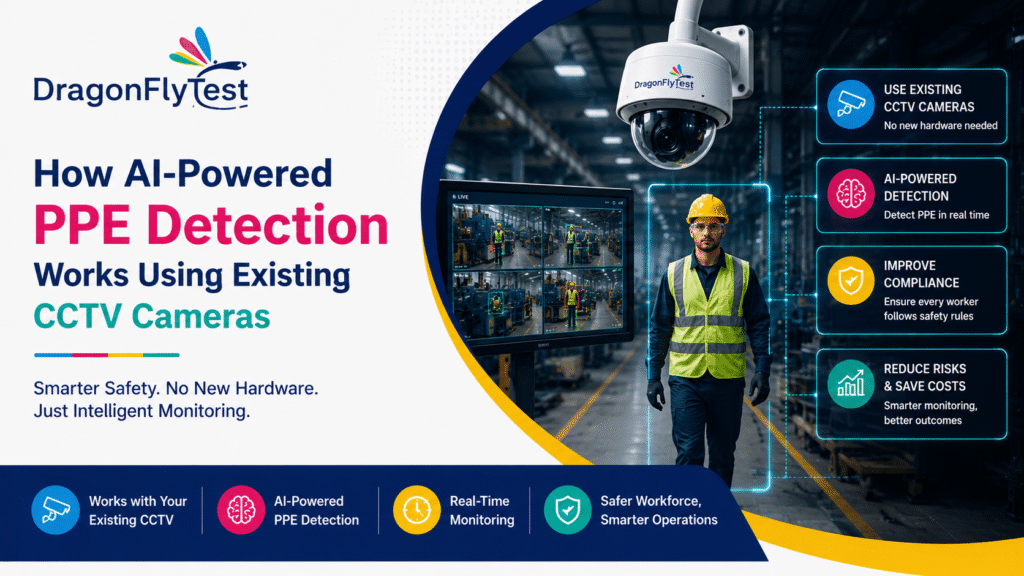
Walk through any busy construction site or manufacturing plant and you will notice two things almost immediately — the constant noise of work being done, and the near-impossible task of making sure every single worker is wearing the right protective gear at the right time. Site supervisors do their best. Safety officers make rounds. Toolbox talks happen every morning. And yet, the moment someone’s back is turned, a helmet comes off, a vest gets left on a bench, or gloves are tucked into a pocket because the work “only takes a second.”
This is where AI-powered PPE detection starts making a lot of sense — not as a replacement for human supervision, but as a system that literally never blinks. What makes it even more practical is that most facilities already have CCTV cameras mounted across their premises. The AI does not need new infrastructure. It plugs into what is already there and starts working.
Here is a straight-forward breakdown of how this technology actually works — from recognizing a helmet on someone’s head to firing an alert before an incident has a chance to happen.
Starting with what you already have — the CCTV setup
Most people assume AI-based safety monitoring requires an expensive overhaul of the existing camera network. That is rarely the case. Modern PPE detection systems are built to work with standard IP cameras, older analog setups through converters, and even low-resolution feeds. The AI model is trained to handle grainy footage, partial obstructions, poor lighting, and different camera angles — because real worksites are messy and unpredictable.
The video feed from each camera is either processed locally on an edge device (a small computer mounted near the camera) or streamed to a central server. Either way, the frames are being analyzed continuously — typically somewhere between 10 and 30 frames per second depending on the hardware and how much detail the site needs captured.
Helmet detection — more than just spotting a hard hat
Helmet detection sounds simple on paper — is the person wearing a hard hat or not? But in practice, the system has to handle a lot of variation. Workers move fast, they crouch, they turn sideways, they stand in shadows. The AI model used for helmet detection is trained on thousands of images showing helmets from every possible angle — front, back, side, tilted, partially hidden behind a beam.
The model uses object detection techniques — specifically something like YOLO (You Only Look Once) or similar architectures — to draw a bounding box around a person’s head and then classify whether a helmet is present within that zone. It checks shape, color patterns associated with hard hats, and positioning relative to the head.
What is worth noting is that the system also differentiates between different helmet types if a site requires it — distinguishing between a standard hard hat and a bump cap, for instance. Some deployments also check helmet color since certain sites use color-coded helmets to identify roles. A visitor wearing white might not be allowed in a zone where yellow is mandatory — the AI can flag that too.
Safety vest detection — picking out high-vis in a crowd
High-visibility vests are among the most commonly required pieces of PPE across industries — road construction, warehousing, airports, oil and gas sites. Detecting them sounds easy because they are bright orange or yellow by design. But the challenge is that camera feeds can wash out colors, workers often wear the vest open or bunched up at the waist, and on a busy site there are reflective surfaces everywhere that can fool a basic color-detection algorithm.
Good PPE detection AI looks for both the color signature and the structural shape of the vest — the distinctive horizontal reflective strips across the torso, the vest outline over clothing. It also checks vest presence relative to the torso bounding box of each detected person, meaning it is not just scanning for orange in the frame but confirming that the orange is where a vest should be on a human body.
One practical limitation worth being honest about — if a worker is facing away from the camera and the vest is only partially visible, confidence scores drop. That is why camera placement matters even in an AI-assisted setup. Positioning cameras at multiple angles in high-risk zones gives the system more data to work with and reduces blind spots.
Gloves detection — the trickiest one to get right
Ask anyone who has worked on AI safety detection and they will tell you the same thing — gloves are hard. Helmets sit on a distinctive round surface. Vests cover a large portion of the body. Gloves are small, they move constantly, hands overlap, tools are held in them, and workers often have them on but tucked partially out of frame. Add in the fact that glove colors vary wildly (black nitrile, blue latex, orange cut-resistant, leather work gloves) and you have a genuinely complex detection problem.
AI systems handling glove detection typically use a combination of hand keypoint detection (identifying where the hands are in the frame using pose estimation models) and then classifying the region around each detected hand. The model is trained to distinguish between bare skin and gloved hands across different lighting conditions and glove types.
For tasks where glove detection is mission-critical — chemical handling, electrical work, high-heat operations — some systems are configured to require a higher confidence threshold before marking compliance. If the system is only 60% sure gloves are present, it may still flag the worker rather than assume everything is fine. That is a configurable threshold, and getting it right requires some calibration based on the specific camera positions and typical worker behavior at that site.
How the real-time alert system actually triggers
Detecting a missing piece of PPE is only useful if someone finds out about it fast enough to do something. The alert mechanism in these systems is usually layered — and for good reason. If every frame that shows a helmetless head generated an alert, supervisors would be buried in notifications within the first hour of deployment.
Most systems use a time-based threshold — the violation has to persist for a set number of consecutive seconds before an alert fires. A worker who bends down quickly and their helmet dips out of frame for half a second is not going to trigger anything. But a worker who has been standing in the loading zone without a vest for twelve seconds? That fires an alert. The threshold is adjustable — stricter zones get shorter windows, lower-risk areas might have a longer tolerance period.
When an alert triggers, it typically goes out through multiple channels at once — a dashboard notification visible to safety officers on a monitoring screen, a push notification to a supervisor’s phone, sometimes an automated announcement over an intercom system in the zone where the violation was detected. The alert includes a snapshot or short clip from the camera showing the violation, the camera ID, the timestamp, and the zone name.
Some systems also log every alert automatically into a compliance record — which ends up being useful for audits, incident investigations, and tracking patterns over time. If one particular zone consistently shows higher violation rates, that shows up in the weekly report. Management can then investigate whether it is a training issue, a workflow problem, or something about the physical layout of that area that makes compliance harder.
Walking through the AI model workflow from frame to flag
For anyone who wants to understand the underlying process, here is roughly how a single frame gets processed from the moment it leaves the camera:
The frame arrives at the processing unit — either edge hardware on-site or a cloud server. The first model to run is a person detection model, which draws bounding boxes around every individual visible in the frame. This step filters out empty areas of the image and focuses computation only on the parts that matter.
For each detected person, the system crops the relevant body regions — head area for helmet checking, torso region for vest checking, hand regions for gloves. These cropped regions are passed to specialized sub-models trained specifically on those PPE categories.
Each sub-model returns a classification result with a confidence score. Above a certain confidence threshold, PPE is considered present. Below it, a violation is flagged for that person in that frame.
The frame-level result is then compared against the previous frames in a rolling buffer. If violations persist across enough consecutive frames to exceed the time threshold, the alert pipeline activates. Notifications go out, the event is logged, and the system continues processing the next frame without interruption.
The whole process — from raw camera frame to a logged alert — typically completes in under 500 milliseconds on decent edge hardware. That is fast enough to be genuinely useful in real time.
A few honest limitations to keep in mind
No technology gets everything right, and PPE detection is no exception. Crowded frames with workers standing close together can cause bounding boxes to overlap. Very poor lighting — night shifts with only partial lighting, for example — does reduce detection accuracy. Camera angles that only show the top of someone’s head or catch workers at extreme distances from the lens will naturally perform worse.
The best implementations treat the AI as one layer of a broader safety program — not the whole thing. It backs up human judgment, fills the gaps during shift changes or when supervisors are stretched thin, and creates an objective record of what was actually happening on the floor. Used that way, it is remarkably effective.
What is genuinely encouraging is how much the models have improved just in the last couple of years. Systems that struggled with dark environments or partial occlusions even eighteen months ago have gotten noticeably better. As training datasets grow and hardware gets cheaper, the gap between what AI can reliably detect and what a trained human eye can catch continues to narrow — and in high-volume environments where no human can watch everything at once, that gap matters a great deal.
Safety culture on any site is ultimately built by people — the way leaders model behavior, how teams hold each other accountable, and whether workers genuinely believe the rules exist to protect them. AI-powered PPE detection does not replace any of that. What it does is make sure that when someone slips up — as people inevitably do — there is a system watching that does not get tired, does not get distracted, and does not look the other way.

 USA
USA