
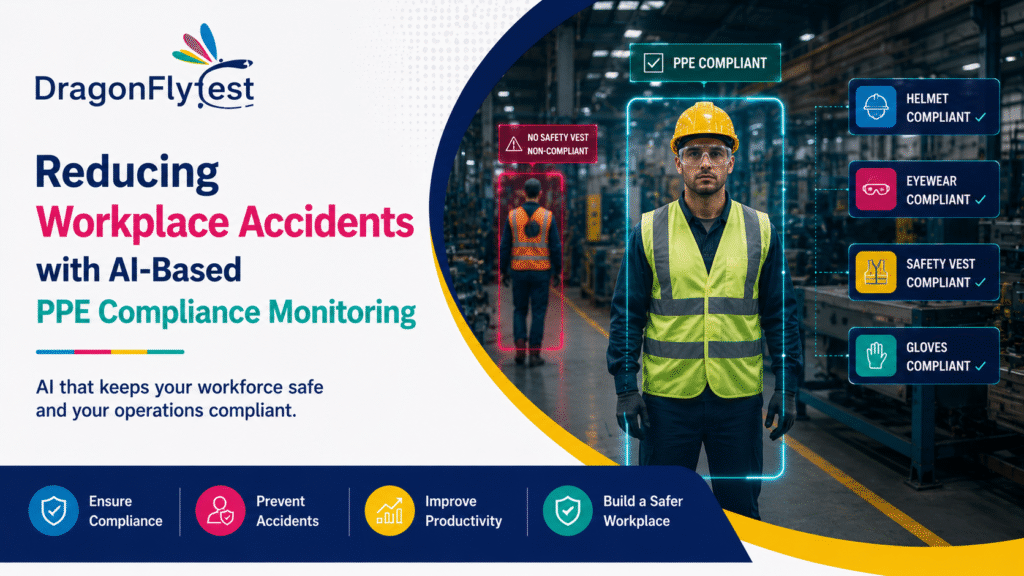
There is a particular kind of frustration that safety managers know well. You run the inductions, you post the signs, you do the toolbox talks every single morning — and still, someone gets hurt because they were not wearing their gloves, or they walked into a live zone without a helmet on. It is not always negligence. People get comfortable. Habits slip. The pressure to move fast wins out over the discipline to gear up properly.
Workplace accidents are rarely random. Most of them have a predictable element somewhere in the chain of events — and for a significant share of injuries across construction, manufacturing, logistics, and heavy industry, that element is a missing or improperly worn piece of PPE. The hard hat that got left on the truck. The safety vest sitting on a hook instead of on a body. The gloves stuffed in a back pocket during a task that needed them on.
AI-based PPE compliance monitoring exists to close that gap — not by replacing safety officers or rewriting safety culture from scratch, but by giving sites a layer of continuous, objective oversight that human beings simply cannot maintain on their own. Here is an honest look at what that actually means in practice.
Why most accident prevention efforts stall before they stick
Ask almost any safety professional where PPE non-compliance happens most and the answer is usually the same: it happens when nobody is watching. The moment a supervisor turns around, the helmet comes off. In a corner of the warehouse where the cameras are sparse. During the last hour of a long shift when attention fades and shortcuts creep in.
Traditional prevention approaches — audits, spot checks, incident reporting, disciplinary frameworks — all have the same structural weakness. They are reactive or intermittent. An audit happens once a month. A spot check covers one zone for fifteen minutes. By the time a pattern of non-compliance becomes visible through these methods, several near-misses have already happened. Statistically, some of those near-misses eventually stop being near-misses.
AI-powered monitoring changes the math. The system watches continuously — every camera, every shift, every hour — and flags violations the moment they occur and persist beyond the alert threshold. This is not about catching people out. It is about making the monitoring consistent so that safety is not something that only matters when someone official is present.
Over time, consistent monitoring changes behaviour. Workers who know that PPE compliance is being tracked — fairly and transparently — tend to maintain it with more regularity. That is not a theory; it mirrors what happened with seatbelt compliance once speed cameras became common. The behaviour shift is not dramatic or overnight, but it is real and it compounds.
What shifts when safety culture gets an honest mirror
Safety culture is one of those terms that gets used a lot without much clarity about what it actually means on the ground. At its core, it is the gap between what a site says it cares about and what actually happens when the pressure is on. Sites with strong safety culture have a small gap. Sites where culture is struggling have a wide one.
AI compliance monitoring contributes to safety culture in a way that most other tools do not — it makes the gap visible. When weekly reports start showing that Zone C has three times the vest violations of any other area, that is a conversation starter. Is it a training issue? Is it that the vest storage point is too far from the entry gate and workers skip it when they are running behind? Is there something about the workflow in that zone that makes compliance harder? The data opens the door to those questions.
It also removes the social friction that comes with selective enforcement. When human supervisors are the only mechanism for catching non-compliance, there is always an element of relationship dynamics involved. The same violation might get a verbal warning from one supervisor and get ignored by another. Over time that inconsistency erodes credibility. An AI system applies the same standard regardless of who the worker is, what shift it is, or how well the supervisor knows them. That consistency is its own form of fairness.
Some sites have found that simply telling workers the system is running — and sharing the weekly compliance data in team meetings — is enough to produce a measurable uptick in PPE use. People respond differently to data about their own behaviour when it is presented as information rather than punishment.
Compliance reporting that actually tells you something useful
Most compliance reporting currently works like this: someone fills in a form after a site walk, the form gets filed, and it sits there until the next audit. The data is retrospective, it is subjective, and it captures a tiny slice of what is actually happening on site. When an incident occurs and investigators pull the compliance records, they often find paperwork that painted a rosy picture right up until something went wrong.
AI-generated compliance reports work differently. Every shift produces objective, timestamped data on PPE compliance across every camera zone — how many individuals were detected, how many violations occurred, how long they lasted, which zones were most affected, and what the trend looks like compared to the previous week. That is a fundamentally different quality of information.
For site managers, the practical value is in the trends. A single bad day can have a dozen explanations. Three consecutive weeks of rising non-compliance in the same zone on the same shift is a pattern that demands attention before it becomes an incident report. AI compliance data makes those patterns visible early enough to act on them.
For companies operating multiple sites, centralised dashboards allow safety leadership to compare compliance rates across locations and benchmark improvement over time. A site that is consistently outperforming its peers on PPE compliance is doing something right — and that knowledge can be shared deliberately rather than discovered by accident after an incident elsewhere.
The insurance conversation most companies are not having yet
Insurance premiums for high-risk industries are calculated based on claims history and the assessed risk profile of the operation. Sites with poor safety records pay more — sometimes significantly more — for their liability and workers’ compensation coverage. That is straightforward enough. What is less commonly understood is that many insurers are now open to adjusting premiums based on demonstrable risk reduction measures, and AI-based PPE monitoring is increasingly appearing on that list.
The reason is not sentimental. Insurers care about claims frequency and severity, and PPE non-compliance is a documented contributor to both. A site that can demonstrate continuous, automated monitoring of PPE compliance — with data showing violation rates, response times to alerts, and downward trends over time — is presenting an underwriter with evidence that meaningful risk controls are in place. That evidence has financial value.
Beyond premium negotiations, the compliance data produced by AI monitoring systems also strengthens a company’s position when claims do occur. If a worker files a claim following an incident and the records show consistent PPE non-compliance in the period leading up to the event — including specific alerts that were responded to — that documentation shapes how the claim is assessed. Conversely, strong compliance data is also a defence when a claim involves disputed facts about what protective equipment was or was not being used at the time.
This is a business case that risk managers and CFOs tend to respond to more readily than safety professionals sometimes expect. The safety argument for PPE monitoring is obvious. The financial argument, framed around insurance costs and claims exposure, often accelerates the conversation considerably.
What real deployments have shown so far
The honest answer is that the published evidence base is still building — AI-based PPE monitoring at scale is a relatively recent development, and many companies running these systems are not rushing to publish their internal data. But enough deployments have produced documented outcomes to sketch a picture of what results look like in practice.
A mid-sized construction contractor operating across several sites in Southeast Asia introduced AI PPE monitoring after a series of hand and head injuries in a twelve-month period pushed their incident rate well above industry benchmarks. In the first six months following deployment, they reported a drop in recorded PPE violations of around 60 percent, measured against baseline data collected during an initial camera-only observation period before alerts were activated. More significantly, the following twelve months passed without a single lost-time injury attributable to missing PPE — the first such period in the company’s recorded history.
A large cold-storage and logistics facility in Europe introduced the system primarily to address glove compliance — a persistent problem in their environment because workers frequently removed gloves when operating touch-screen interfaces or handling paperwork. Within three months, compliance data showed the average duration of glove-removal events dropping from several minutes to under thirty seconds as workers became aware of the monitoring and self-corrected faster. The facility safety manager noted that the AI did not need to generate many alerts — the awareness of the system was itself a sufficient nudge for most workers.
A petrochemical plant piloting the technology in a confined-entry zone found the most immediate value in shift-change periods — historically the highest-risk window for PPE non-compliance because incoming workers were still gearing up and outgoing workers were already mentally off the clock. Real-time alerts during those windows reduced the average time that workers spent in the zone without full PPE from around eight minutes per shift change to under ninety seconds within the first month.
Getting the framing right from the start
One thing that comes up consistently in conversations with safety professionals who have run these deployments is how much the framing matters. Sites that introduced AI PPE monitoring as a surveillance or disciplinary tool ran into immediate resistance — workers felt watched, unions pushed back, and the data that came out was coloured by adversarial dynamics. Sites that introduced it as a safety support tool — something that helped the site meet its own stated goals rather than catching people out — had a meaningfully smoother rollout and better uptake.
That framing is not spin. It is actually the more accurate description of what the technology does. A well-implemented AI monitoring system is not trying to build a disciplinary case against individual workers. It is trying to make sure that the safety standards a site has already committed to are actually being met, consistently, across every hour of every shift — not just when someone with a clipboard happens to be looking.
Used that way, the data becomes something that safety teams, workers, and management can all engage with honestly. Violations go up on a bad week — everyone can see why and talk about it. Compliance improves over a quarter — that gets acknowledged. The numbers stop being a weapon and start being a shared picture of how the site is actually doing.
That shift, more than any specific technology feature, is what makes the difference between a tool that gets switched off after six months and one that becomes a genuine part of how a site operates. Accidents do not just happen. They accumulate from small failures over time — and catching those failures early, consistently, and without bias is exactly what this kind of monitoring is built to do.

 USA
USA