
I remember the first time I saw a parking barrier lift on its own — no ticket, no attendant, no button to press. The car just pulled up, waited maybe two seconds, and in it went. I stood there for a moment thinking, what just happened? That was my introduction to automatic number plate recognition, though I didn’t know the name for it then.
These days, ANPR systems are everywhere — toll booths, border checkpoints, airport car parks, city surveillance networks, private estates. The technology has matured quietly over the past two decades, and the shift from rule-based image processing to AI-driven recognition has been significant. But a lot of people, even those working around these systems daily, don’t fully understand what’s happening under the hood.
This piece breaks it down — the optical character recognition behind the scenes, how vehicles get identified, what kind of cameras the system actually needs, and how the whole recognition workflow strings together from the moment a car enters frame to the moment a database gets updated.
The Reading Part: What OCR Does and Why It’s Harder Than It Looks
Optical character recognition has been around since the 1970s. The basic idea hasn’t changed much — you feed it an image, it identifies characters, and it returns a text string. Simple enough on a clean printed document. On a number plate mounted to a moving vehicle, in rain, at night, at an angle, with mud on it? Considerably less simple.
Traditional OCR systems worked by matching shapes against stored templates. They were brittle — a slightly unusual font or a damaged character could throw the whole thing off. Modern AI-based OCR, particularly systems built on convolutional neural networks, works differently. Instead of matching against fixed templates, the model learns features — curves, angles, intersections — from enormous training datasets. It builds an internal representation of what each character looks like across hundreds of variations.
This matters because number plates are not consistent. In the UK alone there are regional variations, private plates with unusual spacing, older plates with different fonts, and occasional plates from other countries that follow entirely different conventions. An AI-trained OCR engine can handle this variation far better than a template-based system because it’s learned to generalise rather than match.
There’s another wrinkle worth mentioning: segmentation. Before a system can read individual characters, it needs to isolate them from each other and from the background. This sounds trivial, but dirty plates, shadows, reflections, and worn lettering all make segmentation genuinely difficult. Some newer end-to-end models skip explicit segmentation entirely, training the network to produce a text string directly from the plate image. These tend to perform better in real-world conditions, though they require substantially more training data.
Not Just the Plate: How Vehicle Identification Goes Further with Number Plate Recognition
Reading a plate number is one thing. Identifying the vehicle it belongs to is another. In most practical deployments, the two go hand in hand — the recognised plate is checked against a database that returns make, model, registered owner, insurance status, MOT validity, and so on. This lookup happens fast, usually within a second or two of recognition.
But modern AI systems go beyond plate matching. Many now include vehicle attribute recognition — the ability to identify the make and model of a vehicle directly from the image, independent of the plate. This is useful in several ways. It provides a cross-check: if the recognised plate says it belongs to a red Honda Civic but the car in frame is a blue Transit van, something is wrong — possibly a cloned plate. It also allows identification in cases where the plate is obscured, damaged, or deliberately covered.
Vehicle colour detection is now standard in most serious deployments. Colour is extracted from the image and tagged alongside the plate read — useful for filtering in large databases and for corroborating witness descriptions. Some systems also log vehicle type (saloon, SUV, HGV, motorcycle) and direction of travel, building a fairly comprehensive picture from a single camera pass.
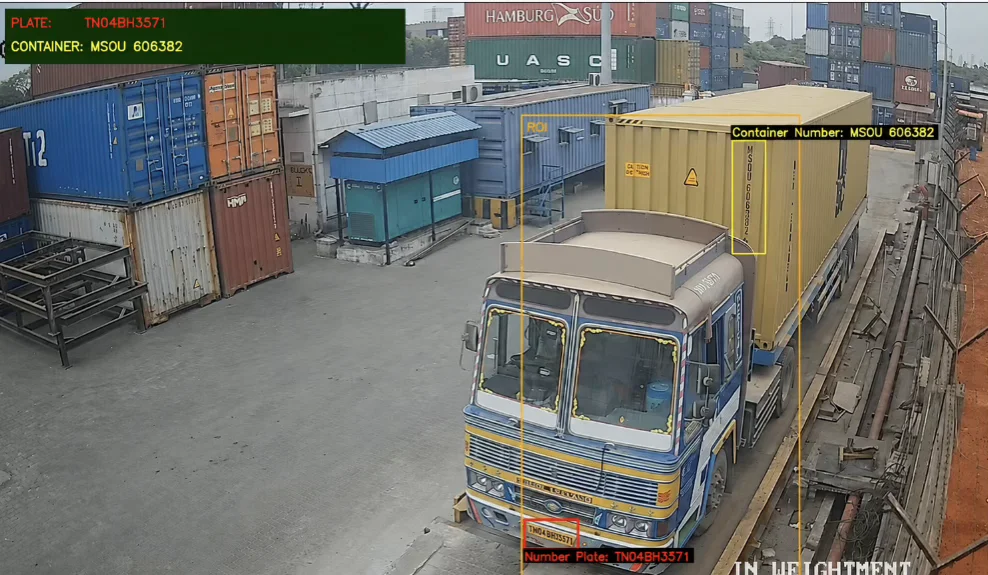
Automated Number Plate Recognition (ANPR) and Container Number Detection Using AI-Powered Video Analytics
For law enforcement applications, the ability to search historical records by vehicle attribute rather than plate is valuable. An investigator looking for a dark-coloured 4×4 seen near a crime scene can query on those attributes even without a plate read. The system returns candidate matches from a pool of millions of logged vehicles, narrowing the search considerably.
Getting the Image Right: Camera Requirements That Actually Matter
A lot of ANPR failures trace back to camera setup, not algorithm failure. The AI is only as good as the image it receives, and poor positioning, wrong lens choice, or inadequate lighting will undermine even a well-trained model.
Resolution is the starting point. A plate needs to occupy enough pixels in the image for characters to be readable. The commonly cited figure is 40 pixels per character height as a minimum, with 80+ pixels per character being more reliable. At typical lane widths and mounting heights, this usually requires a camera with at least 2 megapixels, though 4–8 megapixel sensors are increasingly standard. More pixels give the model more information to work with, which matters especially at the edges of the capture zone where image quality tends to drop off.
Shutter speed is often the overlooked variable. A vehicle travelling at 30 mph covers about 13 metres per second. At a shutter speed of 1/60th of a second, the plate moves over 20 centimetres during the exposure — more than enough to blur characters beyond recognition. Practical ANPR cameras use shutter speeds of 1/1000th of a second or faster. Some systems use stroboscopic illumination — a brief, intense flash synchronised to the shutter — to freeze motion while keeping exposure clean.
Infrared illumination deserves a mention here. Most ANPR cameras use near-infrared illuminators (typically 850nm or 940nm) rather than visible light. Infrared works well at night without blinding drivers, and number plate retroreflective material responds strongly to IR, making the plate stand out cleanly from the vehicle body. Many modern cameras combine IR illuminators with IR-cut filters that can switch modes between day and night operation automatically.
Camera angle affects recognition accuracy more than most people expect. Horizontal capture angles greater than 30 degrees from perpendicular start to cause character distortion that degrades OCR accuracy. Vertical angles matter too — shooting steeply downward compresses characters vertically. Best practice is to mount cameras as close to perpendicular to the direction of travel as the site allows, with the camera height adjusted to give a slight downward angle of 10–20 degrees. This geometry, combined with the right focal length lens, gives the model the cleanest possible image to work with.
From Trigger to Database Entry: Walking Through the Full Workflow
It’s worth stepping through what actually happens from the moment a car enters camera range to the moment a result is logged. The steps are fast — the whole sequence typically completes in under two seconds — but there’s more going on than most people realise.
The first step is vehicle detection. The system needs to know a vehicle is present before it can attempt plate recognition. This is usually handled by a motion detection algorithm running on the video feed — a pixel-difference approach or, in more sophisticated setups, a dedicated object detection model (YOLO-based systems are common here). Virtual detection loops, which mimic the inductive loops embedded in older road systems, can also be implemented in software using camera input. Once a vehicle is detected, the system captures one or more frames for processing.
Plate localisation comes next. A dedicated model scans the captured frame to find the number plate region. This is where a lot of the AI heavy lifting happens — the model needs to identify a rectangular region of the right proportions, in the right area of the image, despite variation in vehicle height, plate position, and ambient lighting. Anchor-based detection networks, trained on large datasets of vehicle images from multiple countries and conditions, handle this reasonably well.
Once the plate region is isolated, it goes through a preprocessing pipeline. This typically includes perspective correction (to straighten a plate captured at an angle), contrast normalisation (to handle glare and low-light conditions), and noise reduction. The goal is to pass the OCR model the cleanest possible cropped plate image.
Character recognition runs on the preprocessed plate image, returning a string along with a confidence score for each character. Systems typically flag reads below a certain confidence threshold for manual review rather than discarding them entirely — a partially confident read is still useful information. Where multiple frames of the same vehicle are available, results from each frame are compared and the highest-confidence read is selected.
The confirmed plate string is then passed to the backend for database lookup. In enforcement applications this means checking against police national computer records or equivalent national databases. In parking applications it might mean checking against a whitelist of authorised vehicles or a live database of paid sessions. The lookup returns whatever data is associated with that plate, and the system logs the event — plate, timestamp, location, camera ID, vehicle attributes — to its own records.
If a match is found against a watchlist (a stolen vehicle, a person of interest, an expired permit), the system triggers an alert. In live enforcement setups this might mean an audible alert to an operator, a message pushed to a patrol unit, or a barrier that stays down. In retrospective analysis setups — where cameras log everything and investigators query the records later — the alert is a search result rather than a real-time action.
A Few Honest Limitations Worth Knowing
ANPR is genuinely impressive technology, but it’s not infallible, and it’s worth being clear-eyed about the gaps. Recognition accuracy varies significantly by condition — most well-deployed systems achieve 95%+ accuracy in good conditions, but that figure can drop sharply in heavy rain, fog, or when plates are dirty or damaged. A 5% error rate sounds small until you’re processing half a million reads a day.
Plate cloning — fitting a legitimate plate to a different vehicle — remains a real problem that AI-based vehicle attribute recognition helps but doesn’t fully solve. Adversarial attacks, where minor physical modifications to a plate are designed to fool recognition systems, are a live area of research. And the databases that ANPR systems query are only as accurate as the records they contain — an unregistered address or a processing delay can mean a legitimate vehicle gets flagged, or an offender slips through.
None of this undermines the usefulness of the technology. It just means the people operating these systems need to understand both what they’re good at and where they’re likely to come unstuck. The AI does a lot of work, but the judgment calls at either end — in system design and in acting on results — remain distinctly human.

 USA
USA