
Industrial Safety | Warehouse Fire Risk | Artificial Intelligence Monitoring
A spark in a building filled with thousands of grocery orders, plastic packaging, cardboard and automated machinery running all the time. By the time the first alarms sounded the fire had already found fuel to become something that conventional suppression could not quickly contain. The warehouse was destroyed. The impact on business continuity was huge running into hundreds of millions of pounds.
This story is worth thinking about because it shows the problem in industrial and warehouse fire safety: these environments are built for efficiency, which often means dense storage, high throughput, reduced staffing and maximum use of floor space. All of these things are directly at odds with the conditions that make fire detection easy. Open space helps smoke travel to sensors. Low fuel density limits how fast a fire can develop. Human presence means someone might see or smell something early. Industrial operations by definition reduce all three.
Artificial Intelligence based early fire detection is gaining popularity in these settings not because it is technology but because it addresses a gap that has existed for a long time. Conventional fire detection was designed for buildings that look nothing like a distribution centre or a continuous-process manufacturing facility. The mismatch has always been there. Artificial Intelligence gives operators a way to close it.
Integrated Fire Safety System Combining Smart Sensors, AI Analytics, and Automated Suppression
Industrial Environments and Why Fire Behaves Differently Inside Them
Walk through a chemical plant, a steel fabrication facility or a large cold-storage warehouse and the first thing you notice is how different these spaces feel from an office or a retail building. The ceilings are often 12 to 20 metres. Which means smoke that rises from a ground-level ignition has a long way to travel before it reaches a detector mounted on the roof. In that time a fire can grow substantially.
The fuel loads are also more concentrated and more varied than in buildings. A warehouse storing goods might have rows of aerosol cans adjacent to stacked cardboard next to pallets of textiles next to battery-powered equipment charging stations. Each of those materials burns differently produces smoke characteristics and accelerates a fire at a different rate. A detection system that is calibrated for one type of fire event may perform poorly when a different material catches first.
Then there is the reality. Industrial facilities do not run like offices. Many run 24 hours. Night shifts have reduced headcount. Automated systems. Conveyor belts, pickers, forklifts operating without drivers. Continue working through quiet periods when the number of humans on the floor who might notice an early problem is minimal. This is when a fire that starts small and builds slowly is most dangerous. Nobody smells it. Nobody sees a wisp of smoke near the back of racking bay 47 at 3 am.
Ventilation systems add another layer of complexity. Industrial HVAC is often powerful and constantly running which means smoke can be dispersed and diluted before it ever reaches a sensor. What should be a concentration of smoke particles that would trigger a conventional detector instead gets spread across a large volume of air drops below detection thresholds and stays there while the fire underneath continues to grow.
Where Conventional Detection Systems Run Into Real Trouble
Point detectors. The sensors mounted at intervals on ceilings and walls. Are the backbone of fire detection in industrial facilities. They work on established principles and they meet regulatory requirements. The problem is not that they do not work; it is that they were not designed for the scale and operational characteristics of industrial environments.
In a 50,000 square metre fulfilment centre the number of detectors required to provide coverage at ceiling level is significant. With full coverage the detection geometry has limitations. A fire starting at floor level in the centre of a racking bay needs to develop enough to push smoke upward and outward to where sensors are positioned. In a high-ceiling space with ventilation that can take four, five, six minutes or more. In a building of lithium-ion batteries or flammable solvents five minutes is a very long time.
False alarm rates are another problem in industrial settings. Point detectors in environments with dust, steam, exhaust welding fumes or chemical vapours generate alarms at much higher rates than in clean environments. Each false alarm costs money. The disruption to operations the emergency response, the cost of repeatedly crying wolf.. Over time false alarms erode the culture of taking alarms seriously. Workers learn to assume it is probably nothing. That assumption, when it turns out to be wrong is catastrophic.
Aspirating smoke detection systems. Which actively draw air samples to a detector. Improve sensitivity significantly and are used in high-risk zones in many facilities. But they are expensive per unit of coverage they require maintenance and they still rely on smoke particles being drawn to a physical sensor location. They do not solve the early-warning problem that cameras can address.
What Artificial Intelligence Monitoring Actually Looks Like Inside a Warehouse
Picture a distribution centre running three shifts. The camera network covers the loading bays, the picking floor the charging stations for electric forklifts the high-bay racking aisles and the goods-in area. Most of those cameras have been there for years installed originally for security and inventory management. They record everything. Do very little with what they see in real time.
Adding an Artificial Intelligence fire detection layer to that infrastructure means those cameras start processing what they see for fire and smoke signatures. Continuously across every shift without fatigue. The Artificial Intelligence model running on an edge device or a connected server analyses video frames and looks for the specific visual patterns that indicate a developing fire situation: the characteristic expansion and drift of smoke the flicker signature of a flame the localised haze that appears in the minutes before smoke becomes dense enough to be obvious.
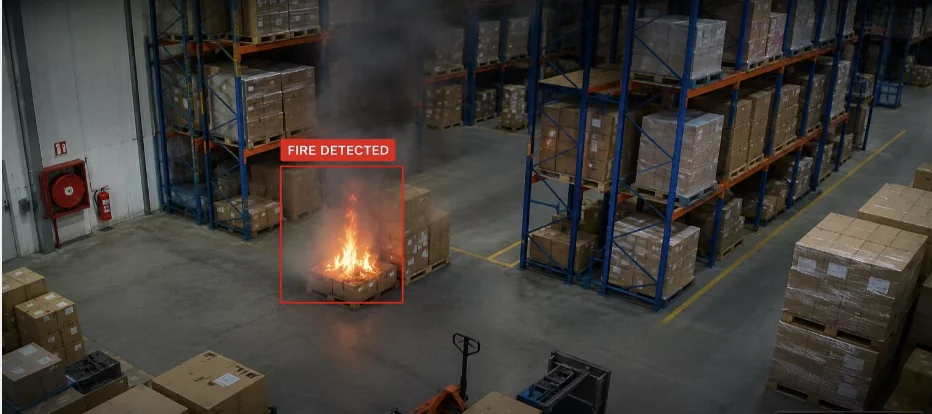
AI-Powered Early Fire Detection System Identifying a Small Fire Incident in a Warehouse Environment
When the model detects something that matches those patterns with confidence across multiple consecutive frames it triggers an alert. That alert goes to a monitoring dashboard to a duty managers phone to a control room display. It comes with a timestamp, the camera identifier and a snapshot showing what triggered the detection. A human looks at it. Within 20 to 30 seconds of the trigger. And makes a call: investigate further escalate or dismiss if it was a false positive.
That human-in-the-loop element matters. The system is not making decisions about emergency response. It is providing a better-informed starting point for human decision-making. The duty manager who gets an alert at 3 am showing a haze developing in charging bay 4 has something to act on. The duty manager who does not have that alert is relying on a sensor that might not fire for another minutes. Or might not fire at all until conditions are already serious.
The Assets at Stake Go Beyond the Building Itself
When people think about warehouse or industrial fires in terms of impact the building tends to dominate the mental model. Rebuild costs, structural damage, the physical replacement of equipment. Those numbers are significant.. They are often not the largest part of the actual financial impact of a major fire event.
Inventory losses in a distribution centre can be huge. A facility handling electronics, pharmaceuticals or high-value consumer goods might have hundreds of millions of pounds of stock in the building at any given time. Insurance covers some of it. Not always all of it and the settlement process takes time. In the meanwhile product that was supposed to be delivered is gone.
Business interruption is the category that tends to be underestimated. A destroyed warehouse does not just mean finding a building. It means finding a new building while simultaneously managing the supply chain disruption communicating with customers who are not receiving orders managing the contracts that are now in breach and absorbing the operational chaos of rebuilding a logistics operation from scratch. Some businesses do not recover. Smaller operations that lack the capital to bridge a long interruption period are particularly vulnerable.
Then there is the cost, which sits outside the financial accounting but is the most consequential part of the whole picture. A fire that develops rapidly in an industrial facility during a night shift. When evacuation routes may be less familiar to the workers present and emergency response takes longer to arrive. Is a scenario where the time between first detection and first alarm is not an operational footnote. It is the variable that determines whether everyone gets out.
Artificial Intelligence detection systems that catch a fire event four to six minutes earlier than a detector are not delivering a marginal improvement. In the context of fire development that window represents the difference between an evacuation that happens in pre-flashover conditions and one that happens after.
Operations That Keep Running When Fire Risk Is Managed Better
There is a less dramatic but commercially important argument for Artificial Intelligence based early detection that often gets overlooked in conversations that focus entirely on catastrophic scenarios. Early detection does not protect against the big fires. It also catches the ones. The smouldering cable that would have grown into something serious overnight the overheating battery that needed attention before it went into thermal runaway the ember from a welding job that landed in a cardboard bin and started working its way through the contents.
Catching those events early means they stay small. A fire that is identified and suppressed at the smouldering stage causes a fraction of the damage. To property to operations to people. That the same fire causes if it is given a five minutes to develop. This is where the operational uptime argument becomes concrete. Facilities that have deployed Artificial Intelligence monitoring report not the absence of major incidents but also a meaningful reduction, in minor fire events escalating into anything requiring operational shutdown or emergency response.
The information that continuous AI monitoring generates is also used for managing risks in many ways that go beyond just detecting fires. When AI systems see patterns in alarms they can show where equipment is getting too hot where there is too much dust or where the way things are done is making it more likely for fires to start. This information is then used to make the facility safer and more efficient by improving maintenance and operations. It is not about detecting fires but also about preventing them.

 USA
USA