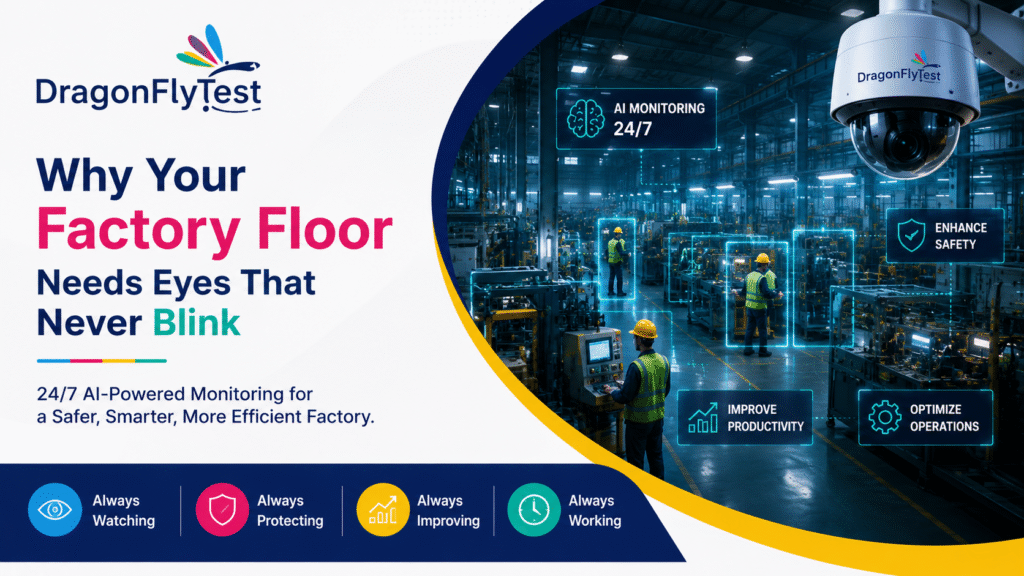
There’s a moment every operations manager knows well. You walk through the production floor, everything looks fine, the numbers from last week’s audit are decent, and then — three days later — a batch gets rejected. Or someone skips a step. Or a machine wasn’t inspected the way it should have been. And nobody caught it.
That moment is why video-based AI compliance monitoring has started showing up in serious conversations about operational efficiency. Not because it’s a trendy tech addition, but because human oversight — as careful and dedicated as it can be — has limits. People blink. People take breaks. People get used to seeing the same thing every day and stop really seeing it at all.
So what exactly is “workflow compliance through video analytics”?
Let’s not bury it in jargon. At its core, it’s this: cameras watch what’s happening on a floor, in a lab, on a production line — and an AI system compares what it sees against what should be happening. Step by step.
It’s not just recording footage for later review. That’s the old way. This is live, real-time analysis where the system understands sequences, timings, and actions — and flags deviations the moment they occur.
Some organizations are using it in pharmaceutical manufacturing, where every single step of a process has to follow a documented standard. Others are using it in food processing plants, automotive assembly, healthcare settings, and logistics warehouses. The industry changes. The problem stays the same: how do you make sure people are doing what the procedure says, every single time?
Walking through how step-by-step process verification actually works in AI Factory Monitoring
Here’s where it gets interesting, and also where a lot of the skepticism lives. People wonder — can a camera really know if a step was done right or just done?
The short answer is: it depends on how the system is trained. And the good ones are trained rigorously.
What the AI learns is a sequence model. Say a worker needs to: pick up a component, inspect it visually, apply a torque tool to a specific point, set it down, and log the action on a terminal. That’s five steps. Each has a visual signature — a body pose, a tool interaction, a location in the frame, a duration.
The AI Factory Monitoring watches for those signatures in order. If step three happens before step two, it knows. If step four gets skipped entirely, it knows. If the torque tool is held for two seconds when it should be held for eight, that’s detectable too.
What makes this different from older motion detection systems is the contextual understanding. It’s not just “something moved.” It’s “a person picked up object X and interacted with surface Y for Z duration, and that sequence either matches or deviates from the expected pattern.”
Getting there takes a lot of initial setup — annotating video examples, defining what each correct step looks like under different lighting conditions, different worker builds, different shift speeds. That investment upfront is real. But once it’s done, the system runs without fatigue.
Tracking workflows across longer processes — not just single tasks
Single-task verification is one thing. But real production environments often have workflows that span multiple stations, multiple workers, and sometimes multiple hours.
This is where workflow tracking becomes its own challenge. You’re no longer looking at one person doing one thing. You’re tracking an item — or a batch, or a vehicle — as it moves through a defined sequence of stations. Every handoff matters. Every dwell time matters. Every station that was supposed to touch the item and didn’t, matters.
Modern systems handle this through a combination of object tracking, worker identification (usually through anonymized silhouettes or badge-based tagging, not facial recognition), and station-level event logging. The AI maintains a live map of where things are in the workflow and flags when something falls out of order.
Think of it like a digital traveler — the system knows where a product is supposed to be at every stage of its journey through the floor. When it shows up somewhere unexpected, or when it stays in one place too long, an alert gets raised.
For managers, this turns the production floor from a place you walk through and hope everything’s fine, into something closer to a dashboard — with live status on every active workflow.
What “AI event detection” actually means on the ground
People sometimes think event detection means the system catches disasters. An injury. A machine fire. And yes, those are detectable events. But the more operationally useful version is subtler than that.
AI event detection in a compliance context means catching things like: a worker bypassing a required check and moving to the next step anyway; PPE that should be on — gloves, safety glasses, a hairnet — that isn’t; a step that’s being done out of sequence because someone’s rushing; an inspection that was logged as complete but the camera shows no one actually walked over to that section; a tool that wasn’t sanitized between uses in a setting where that matters enormously.
These aren’t dramatic. They’re the kind of thing that happens quietly, repeatedly, and only surfaces when there’s a quality problem downstream or — in a worst case — a safety incident.
The detection itself works by comparing live visual data against models built from hours of correctly performed procedures. Deviations trigger tagged events in the system. Those events can be logged silently for later review, or they can trigger immediate alerts — an audible signal, a supervisor notification, a flag on the line management system.
Most organizations start with logging and review. Then they add live alerts once they’ve calibrated the system well enough that false positives aren’t making everyone anxious all the time.
Real-time monitoring — where the human-machine relationship actually matters
Here’s something that doesn’t get talked about enough in these conversations: real-time monitoring only works well when the human response side is thought through carefully.
If a system is flagging fifteen events an hour and nobody’s designated to act on them, the value disappears quickly. Alert fatigue is a very real operational risk with any live monitoring system.
The facilities that get the most out of real-time compliance monitoring tend to do a few things differently. They tier their alerts — not everything is a three-alarm fire. A skipped log entry is different from a worker entering a restricted area, which is different from a safety-critical step being omitted. The system routes different severity events to different people, through different channels.
They also treat the data as a feedback tool, not just a catch-people-making-mistakes tool. When you can see that a particular step gets skipped 40% of the time on the afternoon shift, that’s not just a disciplinary issue — that’s a workflow design problem. Maybe the step is confusing. Maybe the tooling makes it physically awkward. Maybe there’s a bottleneck upstream that creates time pressure.
Real-time visibility turns those patterns visible. And that’s arguably more valuable than the individual catches.
A few honest things worth knowing before you go down this road
The technology works, but it’s not plug-and-play. The initial training phase takes time, and it requires real cooperation from the people on the floor — both to capture good example footage and to build trust that the system is there to improve things, not just watch them.
Privacy concerns are legitimate and need to be addressed head-on with employees. The best implementations are transparent about what’s being recorded, how it’s used, who sees it, and what it isn’t being used for (like performance scoring for compensation decisions, or feeding into HR files directly).
Integration with existing systems matters more than most vendors admit upfront. The AI can generate all the event data in the world, but if it’s not connected to your MES, your quality management system, or at minimum a sensible alerting interface, it becomes an island.
And last — pick the right environments first. Lines or processes where the steps are clearly defined, the physical space is consistent, and the compliance stakes are highest. Start there. Get the calibration right. Then expand.
Where this is heading
The honest trajectory is toward more autonomous verification loops — systems that not only detect deviations but can pause a process automatically, request re-inspection, or flag a batch for hold before it moves downstream. Some facilities are already there in limited applications.
But the more grounded near-term value is simpler: giving operations teams visibility they genuinely don’t have right now. Not because they’re not trying, but because the floor is large, the shifts are long, and the procedures are complex.
AI-driven video analytics doesn’t replace the judgment of an experienced operator. It gives that operator better information, faster, with a much wider field of view than any one person can maintain. That’s a genuinely useful combination — and it’s why this particular application of AI is gaining real traction in places where compliance isn’t optional.

 USA
USA