
AI testing used to be simple.
You send an input, you check the output, and you move on.
That approach starts breaking the moment you work with modern LLM-based systems. If you’ve spent even a little time with them, you’ve probably seen this happen: you give the same input twice, and you get two different answers. Not because something is broken, but because the system is using different context behind the scenes.
That’s where Model Context Protocol (MCP) comes in.
MCP is what decides what context the model sees. And once context becomes part of the system, testing stops being straightforward. You’re no longer validating a single response—you’re trying to understand a chain of decisions that led to that response.
The tricky part is that most teams don’t realize this early enough. They build MCP-based systems, test a few happy paths, and assume things are working fine. Then things start behaving oddly in production, and it’s hard to trace why.
This write-up is based on that gap—what actually needs to be tested when context is involved.
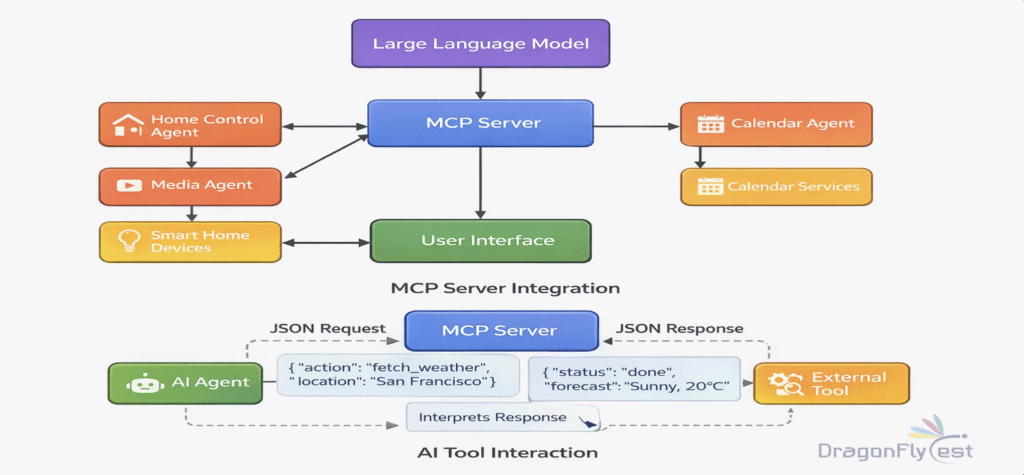
What MCP Really Does (Without Overcomplicating It)
If you strip away all the fancy terminology, MCP is just managing context.
Instead of sending a clean prompt to a model, the system does a lot of work before that:
- It pulls past conversation history
- It fetches stored memory (preferences, previous answers, etc.)
- It may call tools to get fresh data
- It decides what is important and what can be ignored
Only after all that does it build the final prompt.
So when the model responds, it’s not reacting to just one input—it’s reacting to everything MCP decided to include.
And that’s exactly why testing gets messy.
Why Test MCP Systems Feels Different
In traditional systems, if something goes wrong, you can usually trace it back to a specific input or logic issue.
With MCP, things fail in quieter ways.
Sometimes the output looks fine at first glance, but it’s based on the wrong context. Other times, the system behaves correctly for a while and then slowly drifts into something inconsistent.
The biggest shift is this:
you’re not just testing correctness anymore—you’re testing relevance.
You start asking questions like:
- Did the system use the right piece of information?
- Did it ignore something important?
- Did old context override new input?
These are not things you can catch with basic test cases.
Testing MCP Servers: Where Context Lives and Changes
One of the first places things go wrong is in how context is stored and updated.
Let’s take a simple example.
A user interacts with a support assistant:
Step 1:
“My preferred language is Telugu.”
Step 2:
“Actually, switch to English.”
Step 3:
“Explain my billing issue.”
If the system still replies in Telugu, something is clearly off.
What makes this interesting is that everything might look correct at the API level. Requests are successful, responses are valid. But internally, the system failed to update context properly.
In practice, this happens more often than you’d expect.
To catch this, you need to stop testing requests in isolation. Instead, you test sequences.
Run interactions step by step and observe how context evolves. Don’t just look at the final answer—look at whether the system is remembering, updating, and prioritizing information correctly.
A useful habit here is to deliberately introduce changes:
- Update preferences
- Contradict earlier inputs
- Add irrelevant data
Then see what the system holds onto.
You’ll quickly find out whether it’s actually managing context or just accumulating noise.
Testing the Pipeline: What Actually Reaches the Model
Another area where things quietly break is the pipeline that prepares the prompt.
Even if context is stored correctly, it still needs to be selected and injected properly. And this is where a lot of subtle bugs hide.
A situation I’ve seen more than once:
a system retrieves multiple past interactions, but due to token limits, the most important one gets dropped.
The model still produces an answer, but it’s slightly off. Not obviously wrong, just not what you’d expect.
These are the hardest bugs to catch because nothing crashes.
One thing that helps a lot here is inspecting the final prompt. If you can log what actually goes into the model, you start seeing patterns:
- Important context missing
- Duplicate entries showing up
- Less relevant data taking priority
Another simple technique is to run the same query under different conditions:
- With full history
- With partial history
- With no history
If the answers barely change, context isn’t being used effectively.
If the answers change too much, the system may be unstable.
You’re looking for controlled influence—not randomness.
Failure Scenarios You Don’t See Coming
Test MCP Systems fail in ways that don’t show up in standard testing.
One example is context drift.
Everything works fine in the beginning, but as the conversation grows, responses start becoming less relevant. The system begins mixing in unrelated information or losing focus entirely.
Another issue is context poisoning.
If a user provides incorrect information and the system stores it blindly, that mistake carries forward. Later responses are built on top of that bad data, and things slowly go off track.
There’s also tool misalignment.
In systems where the AI can call external tools, incorrect context can lead to selecting the wrong tool altogether. This doesn’t always fail loudly—it just produces the wrong outcome.
And then there’s the case where fresh input gets ignored.
A user explicitly changes something, but the system continues behaving based on old context. From the user’s perspective, this feels like the system isn’t listening.
To test these, you need to be a bit creative.
Don’t just follow expected flows. Break things intentionally:
- Feed incorrect data
- Change instructions midway
- Stretch conversations longer than usual
You’re trying to see how the system behaves when things aren’t clean.
Contract Testing: Where AI Meets External Tools
This part is often overlooked, but it causes real issues.
When AI interacts with tools, the communication is structured. But even small differences in how data is returned can lead to misunderstandings.
For example, a tool might return:
{ “status”: “done” }
But the AI expects:
{ “status”: “completed”, “data”: {…} }
From a human perspective, these look similar. But for the system, they can mean different things.
The result is not always a failure—it’s often a wrong decision.
What makes this tricky is that traditional contract testing focuses on structure. As long as the JSON format is valid, things seem fine.
But with AI systems, structure isn’t enough. Meaning matters.
So when you test this layer, don’t just check if fields exist. Check how the AI interprets them. Does it take the correct next step? Does it misunderstand ambiguous values?
That’s where most issues hide.
Concluding Remarks
Your approach to quality is altered by testing MCP systems.
Isolated outputs are no longer being verified. You’re examining decision-making processes, information flow, and system behaviour over time.
Consistency and dependability are more important than rigorous accuracy.
This area is still developing at the moment. The majority of teams concentrate on developing features rather than thoroughly testing them. Because of this, a lot of problems only become apparent until actual users engage with the system in novel ways.
You’ll identify issues that others overlook if you begin observing context early on, including how it’s stored, used, and changed.
And that is crucial in systems where behaviour is driven by context.
🔗 Partner with the Experts. Claim Your Free POC today!
📩 Connect With Us:
🌐 Website: www.dragonflytesting.com

 USA
USA