
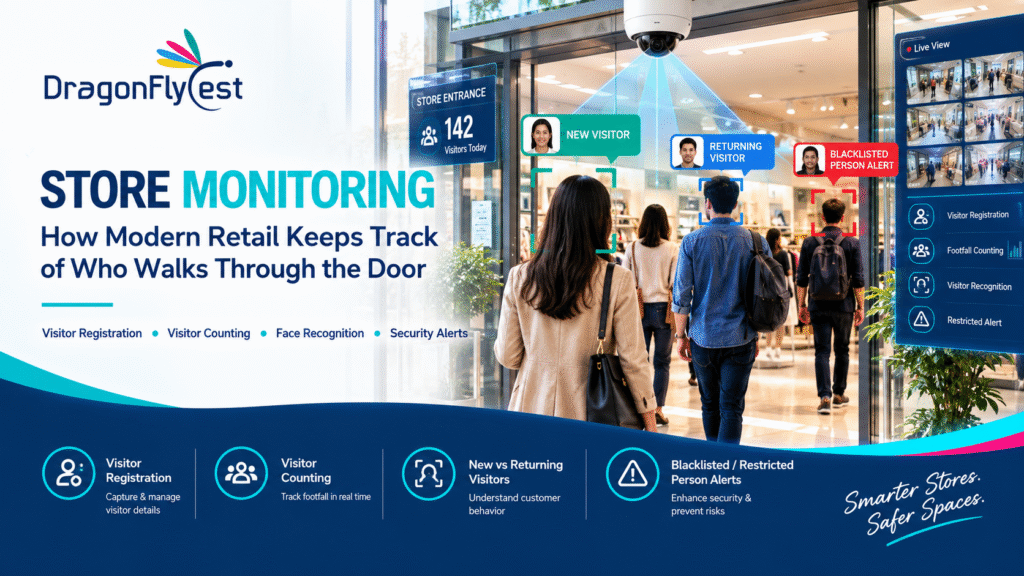
Store Monitoring: How Modern Retail Keeps Track of Who Walks Through the Door
Every retail store, no matter how small, has always kept some kind of eye on who comes in and out. For decades that meant a security guard by the entrance, a manager glancing up when the bell above the door rang, or a grainy CCTV feed nobody watched until after something went missing. That approach worked, sort of, but it depended entirely on a human being paying attention at the right moment. Today, a lot of that job has shifted to systems that never blink, never get distracted, and never forget a face they’ve already flagged.
Store monitoring has quietly become one of the more sophisticated corners of retail operations. It’s no longer just about catching shoplifters on camera. It’s about understanding footfall, recognizing patterns in who visits and when, and — increasingly — automatically flagging individuals who shouldn’t be on the premises at all. This post walks through four pieces of that puzzle: visitor registration, visitor counting, distinguishing new from returning visitors, and identifying blacklisted or restricted individuals the moment they walk back in.
Visitor Registration: The Front Door Gets Smarter
Visitor registration sounds like something you’d expect at a corporate office lobby, not a retail store, but it’s shown up in more contexts than people realize. High-value stores — jewelers, electronics retailers, luxury boutiques — often ask visitors to sign in, either on paper or through a digital kiosk, especially outside regular trading hours or for appointment-based shopping. Warehouses and back-of-store areas attached to retail operations use it too, since not everyone walking through a stockroom is a customer.
Digital registration systems have mostly replaced the paper sign-in sheet, and for good reason. A paper log is only useful after the fact, if someone bothers to read it. A digital kiosk or tablet-based system captures a name, sometimes an ID scan or a photo, and timestamps the entry automatically. That record becomes searchable. If an incident happens at 3:15pm, staff can pull up exactly who was registered as present around that time instead of squinting at illegible handwriting from three weeks of unsorted sign-in sheets.
There’s a customer experience angle here too. A well-designed registration flow — quick, not intrusive, maybe just a QR code scan that opens a short form on a visitor’s own phone — doesn’t feel like a security checkpoint. It feels closer to checking in for a table at a restaurant. The friction matters. Stores that make registration feel like an interrogation lose customers before they’ve even started browsing. The ones that make it feel like a formality, barely worth mentioning, keep both the security benefit and the customer experience intact.
Visitor Counting: Numbers That Actually Mean Something
Ask most store managers how many people walked through their doors last Saturday and, without a counting system, they’re guessing. Visitor counting fixes that with sensors — usually a mix of overhead cameras, infrared beam counters at entrances, or Wi-Fi and Bluetooth signal detection — that tally footfall automatically, all day, without anyone standing at the door with a clicker.
The obvious use is staffing. If a store consistently sees a footfall spike between 5pm and 7pm on weekdays, that’s a scheduling decision, not a guess. Fewer staff on the floor during quiet mid-morning hours, more during the after-work rush. Retailers who’ve adopted this kind of data-driven scheduling tend to report both lower payroll waste and shorter checkout queues during peak periods — you can’t fix a problem you haven’t measured.
But footfall counting also feeds into conversion analysis, which is where it gets genuinely interesting for a business. If a store counts 400 visitors on a given day but only rings up 60 transactions, that 15% conversion rate tells a very different story than raw sales figures alone. A low number might point to poor product placement, an understaffed floor during busy hours, or pricing that’s pushing people to browse and leave rather than buy. None of that shows up if the only number a store tracks is revenue.
Counting also matters for something far more basic: occupancy limits during fire safety planning, and in some regions, legal capacity restrictions that stores are required to enforce. A system that automatically counts people in and out removes the guesswork from compliance that used to depend on a staff member manually tallying a clicker counter, a method that’s about as reliable as it sounds.
New vs. Returning: Recognizing a Familiar Face
Counting how many people walked in tells you volume. It doesn’t tell you whether those are 400 different people or the same 150 regulars showing up more than twice a week. That distinction matters enormously for how a retailer thinks about its customer base, and it’s where facial recognition and other identification technologies have started playing a bigger role in store monitoring.
Modern systems can distinguish a first-time visitor from someone who’s walked in before, without requiring either person to register or present ID. The technology typically works by generating an anonymized facial signature from camera footage and comparing it against previous visits, flagging a match if one exists. Done properly — with the anonymization and data retention limits that privacy regulations increasingly require — this doesn’t identify a person by name. It simply recognizes “this face has been here before” versus “this is a new face.”
That distinction feeds directly into marketing and loyalty decisions. A store that can see returning visitor rates climbing after a layout change or a new product line has actual evidence that something is working, rather than relying on anecdotal impressions from staff. It also helps flag the opposite problem — a store with high new-visitor traffic but very low return rates might be attracting people through advertising or foot traffic location, but failing to give them a reason to come back. New-versus-returning data turns that vague sense of “we don’t seem to have many regulars” into an actual measurable trend a manager can act on.
It’s worth being upfront that this is the most sensitive piece of store monitoring technology, and the one facing the most regulatory scrutiny worldwide. Retailers using facial recognition for new/returning identification need to be transparent about it, typically through signage at entrances, and need to follow local data protection law closely — retention periods, opt-out mechanisms, and what happens to the biometric data once it’s captured all vary significantly by jurisdiction. The technology’s usefulness doesn’t remove the obligation to handle it responsibly.
Blacklisted and Restricted Persons: The Alert That Actually Matters
This is where store monitoring stops being about business analytics and becomes a direct safety and loss-prevention tool. Retailers — particularly larger chains — often maintain a list of individuals who are legally or administratively barred from entering a specific location. This could be someone with a documented history of theft, a person under a formal trespass notice, an individual involved in a previous violent incident on the premises, or someone flagged under a restraining order that names the property.
Historically, enforcing this kind of restriction depended entirely on staff memory, which is a genuinely weak link. Security guards change shifts. New hires haven’t seen the internal bulletin with a photo from six months ago. A person barred from one location in a chain could simply walk into a different branch without anyone recognizing them at all. Store monitoring systems close this gap by matching faces captured at the entrance against a stored blacklist, and doing it in real time, at every door, on every shift, without depending on anyone’s memory.
When a match occurs, the system doesn’t just make a quiet note in a log file somewhere for someone to find later. It triggers an immediate alert — typically routed to store management or a security desk via text, email, or an internal app notification — often including a snapshot of the individual as they entered. That immediacy is the entire value proposition. A blacklist that only gets checked after an incident has already happened is a records tool, not a prevention tool. A blacklist that fires an alert the moment a restricted person walks through the door gives staff the chance to respond before anything escalates — whether that means a manager calmly approaching the individual, contacting site security, or in more serious cases involving law enforcement based on the terms of an existing order.
This is also an area where the technology has to be paired with clear, well-documented policy. Who gets added to a blacklist, on what basis, and who reviews and removes names over time all need to be defined processes, not informal decisions made by whoever happens to be managing the store that week. A system that’s accurate but governed poorly creates its own risks — misidentification, outdated entries, or restrictions applied without proper review. The technology handles detection; the policy around it has to handle fairness and accountability.
Putting the Pieces Together
None of these four capabilities exist in isolation on a well-run system. Visitor registration captures who’s expected to be somewhere specific. Visitor counting gives a retailer the raw numbers to plan staffing and measure conversion. New-versus-returning identification turns those numbers into a picture of loyalty and customer behavior. And blacklist alerting closes the loop on the one thing all the analytics in the world can’t compensate for — keeping a genuinely restricted individual off the premises before something goes wrong.
What ties them together is the shift from monitoring that happens after the fact to monitoring that happens in real time. A footage archive that gets reviewed once a week after a theft is a very different tool from a system that recognizes a returning shoplifter at the door and alerts a manager before they’ve picked up a single item. Retailers investing in this kind of infrastructure aren’t just chasing a security upgrade — they’re replacing a system built entirely on human attention and memory with one that catches what people, understandably, sometimes miss.
The tradeoff, and it’s a real one, is the responsibility that comes with holding this much data about the people walking through a door. Footfall numbers are harmless. Facial recognition and blacklist matching are not something to bolt on casually. Retailers who get the balance right — genuinely improving safety and operations while being transparent and disciplined about data handling — end up with something that protects both the business and the people walking through it, rather than a system that quietly erodes the trust it was supposed to protect.

 USA
USA