
The access card problem nobody talks about, but everyone has lived through
A client we worked with last year had a problem they struggled to put into words at first.
Their facility had access cards for every employee. Attendance was logged automatically. Entry points were monitored. On paper, everything functioned.
But spend a week inside their operations and a different picture emerges. Cards got left at home, so a colleague would lend theirs. Someone was marked absent on a Tuesday because they used a visitor badge after forgetting their card. HR fielded three or four attendance disputes every week — each one routine, each one requiring someone’s time to untangle.
The real cost wasn’t the disputes themselves. It was the hours spent cross-referencing logs, the quiet frustration of staff who knew the records were wrong, the low-level trust erosion that built up gradually between departments.
When we introduced facial recognition as a potential fix, the initial reaction was cautious. It felt like overkill — wasn’t this the kind of thing used in airports and police investigations? That hesitation is completely understandable. But it also reflects how much the technology has quietly changed. The face recognition most people picture — slow, unreliable, requiring controlled conditions — isn’t what organisations are actually deploying now.
Where the technology started, and why those early systems kept letting people down
The first commercial face recognition systems measured distances between facial features and compared those measurements against stored templates. In theory, it should have worked. In practice, it struggled constantly.
Lighting was the biggest problem. A face photographed in bright sunlight generated measurements that looked nothing like the same face under fluorescent office lighting. Glasses, facial hair, even a slight change in camera angle could push the match score below the threshold. Real-world environments are never the controlled conditions these systems required.
What changed the situation wasn’t a single breakthrough — it was deep learning, large-scale training data, and cheaper computing power arriving together over roughly a decade. These three things, maturing simultaneously, transformed what face recognition could actually do.
What deep learning actually changed
Traditional systems followed rules humans wrote. Deep learning identifies patterns humans can’t fully articulate.
A model trained on millions of faces doesn’t memorise specific measurements. It develops an internal sense of identity that’s remarkably robust to variation — different lighting, a beard that appeared six months ago, reading glasses, a camera at an awkward angle. The model learns, implicitly, that these are the same person. Not because anyone told it — because it encountered thousands of similar variations during training and adjusted accordingly.
The practical result is that today’s systems handle conditions that would have made a 2005 system useless: recognition through partial occlusion, matching from low-resolution cameras, identifying people in motion. Failure modes still exist, but the gap between controlled-conditions performance and real-world performance has narrowed enough to make commercial deployment genuinely viable.
Access control — what actually changes when you replace a card with a face
The appeal of biometric access isn’t primarily about security. Most organisations adopting it aren’t dealing with sophisticated intrusion attempts. The appeal is operational: a face is a credential you can’t forget, lose, or lend without immediately obvious consequences.
When our client implemented facial recognition at their entry points, the most immediate change was the elimination of daily friction. Nobody was standing at the door patting their pockets. The steady stream of access-related interruptions simply stopped.
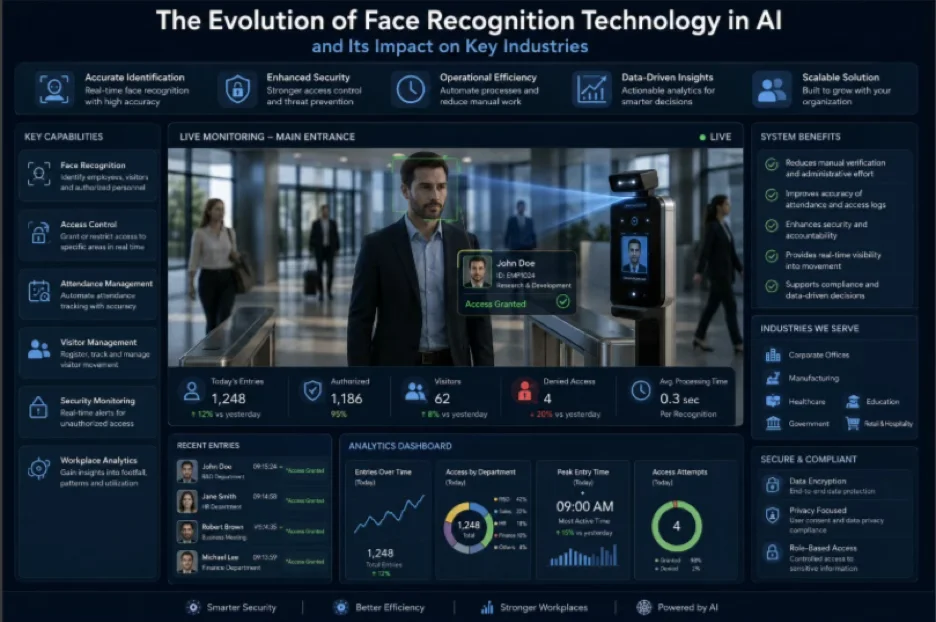
The longer-term change was record reliability. When attendance is tied to a biometric rather than a card, the log reflects actual presence. Disputes don’t disappear entirely, but the whole category that comes from card sharing or forgotten credentials largely goes away. For larger organisations managing multiple buildings, restricted areas, and contractor populations, these benefits compound quickly.
Attendance management is boring to talk about and genuinely valuable to fix
Nobody gets excited about attendance management. It hums along invisibly when it works and becomes a quiet source of organisational irritation when it doesn’t.
Card-based systems have well-understood weaknesses. Cards get shared between colleagues, especially in shift environments. People forget to badge out. Multi-site organisations struggle with inconsistent records. Face recognition addresses these directly — the record is generated from an actual biometric match, not a card that could have been carried by anyone, and the process takes seconds without requiring anything extra from the employee.
The gains show up in payroll accuracy, reduced HR time spent on corrections, and cleaner data for workforce planning. They’re not dramatic improvements — they’re the kind of incremental operational wins that accumulate into something meaningful over months.
Healthcare, retail, and industrial environments — each with its own version of the same argument
Healthcare is interesting because the operational pressures are distinctive. A large hospital manages hundreds of employees across dozens of departments, plus contractors, vendors, students, and visitors — all with different access permissions across different areas. Card-based systems handle this through credential categories, which works until someone’s card is lost or a contractor’s temporary access isn’t properly deactivated. Face recognition ties permissions to a verified identity and updates them centrally the moment a certification lapses or a role changes.
Retail applications attract more public scrutiny, and some of that scrutiny is warranted. Collecting biometric data from members of the public who haven’t explicitly consented is a genuine ethical concern, and the regulatory environment is shifting. Within those constraints, loyalty programme recognition and loss prevention applications have practical value — but responsible deployment requires genuine engagement with privacy considerations, not just compliance box-ticking.
Industrial environments tend to make for the cleanest deployments. Manufacturing facilities often need strict access controls tied to safety certifications. A card doesn’t know whether the person carrying it has actually completed the required training. Face recognition closes that gap by tying access directly to a verified, up-to-date identity profile.
The honest part — limitations that don’t always get mentioned
Face recognition works well in well-designed deployments and less well in poorly designed ones. Camera placement matters enormously. A camera positioned at the wrong height, or in a space with challenging backlighting, will underperform regardless of the algorithm. Enrollment quality matters too — a poor reference image produces unreliable matching.
Accuracy across demographic groups is a real issue. Early systems showed higher error rates for darker-skinned individuals and women. Modern systems trained on more diverse datasets have improved, but the gap hasn’t fully closed. Organisations have a responsibility to test performance across their actual user population rather than assuming benchmark results will transfer.
Privacy communication isn’t optional. Employees and visitors have a reasonable interest in knowing what biometric data is collected, how long it’s kept, and who can access it. Treating this as a compliance formality rather than a genuine responsibility tends to produce exactly the kind of trust problems that undermine the operational benefits you were pursuing. And data security for biometrics needs to reflect a basic reality: if a password is compromised, you change it; you can’t change your face.
What we’ve actually learned watching organisations go through this
The projects that deliver genuine value start with an operational problem rather than a technology decision. They identify a specific friction point — attendance disputes, access record inaccuracies, visitor management overhead — and evaluate face recognition against that problem. The technology either addresses it well or it doesn’t.
The projects that disappoint tend to start with the technology. Someone encounters a compelling demonstration, champions the capability internally, and the project gets built around the tool rather than a clear need. These deployments often produce impressive demonstrations that don’t translate into day-to-day value.
The underlying tools are better than they’ve ever been. Whether a deployment actually succeeds still comes down almost entirely to how clearly an organisation understood the problem it was trying to solve before it started.

 USA
USA