
Introduction:
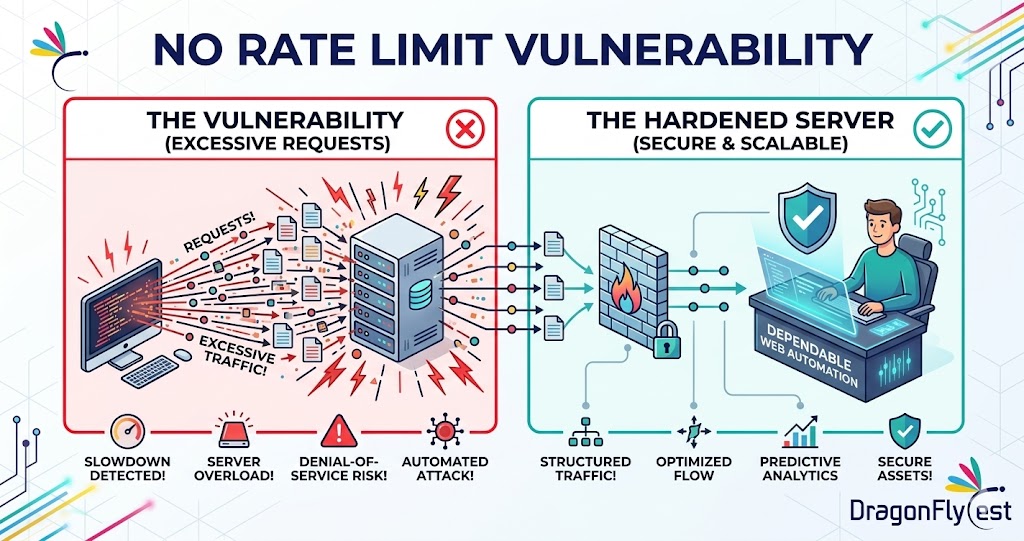
Mechanisms that limit how many requests a user or system can submit in a certain amount of time are crucial for preserving availability and security in contemporary online applications and APIs. A No Rate Limit vulnerability arises when these controls are absent or implemented incorrectly.
An application has a No Rate Limit vulnerability when it permits excessive or limitless requests. Attackers may use this vulnerability to quickly carry out automated and repetitive tasks, posing significant security threats. Brute-force attacks on login systems, credential stuffing, OTP (One-Time Password) bypass attempts, API misuse, and resource exhaustion are examples of common attack scenarios.
Attackers can repeatedly submit requests to guess passwords, list user accounts, or overload the system if rate limitation is not in place.
It is essential to:
Avoiding mistreatment
Preventing overload on APIs
preventing DoS and brute force attacks
An application is susceptible to uncontrolled traffic in the absence of rate limitation, which may result in data compromise or service interruption.
What is No Rate Limiting:
No Rate Limiting is a security vulnerability where a web application fails to restrict the number of requests a user or bot can make within a specific timeframe.
How a No Rate Limit vulnerability Works:
A “no-rate limit” vulnerability occurs when an application fails to restrict the number of requests a user can make within a specific timeframe, allowing unlimited actions. This flaw enables automated attacks like brute-forcing logins, email bombing, or API abuse.
Unrestricted Access: High-volume traffic on sensitive endpoints, such as login, OTP validation, or password recovery, is permitted since the server handles every request, regardless of frequency.
Missing 429 Errors: A 429 Too Many Requests error is returned by legitimate rate limiter. In the absence of protection, attackers can quickly test thousands of passwords or codes using software.
Automated Brute-Forcing: Since the server doesn’t stop or block requests, attackers can quickly submit thousands of credential combinations to get around authentication.
Abuse of Business Logic: If there are no restrictions, attackers can take advantage of capabilities like sending repeated API queries or redeeming infinite coupons.
No Rate Limit On Account Creation:
We will send X number of Simultaneous request to the Server and Server will act on Each request.
Thus, Making X number of email accounts on the Website
No validation (or) Limiting the requests and Taking decisions is dangerous.
First Capture the request in Burp suit
Send to intruder
Start attack Success code 200 .
No Rate Limit Leads to ATO:
We will send X number of Simultaneous request to the Server and Server will act on Each request.
Thus, by sending X number of right OTP Token , Password we can Successfully Crack the code
No Validation or Limiting the requests and taking decisions in dangerous
First enter the invalid otp
Then capture the request
Then send the request to intruder
Then start the Brute Force attack
Set the range like 15 to 25 in payload
Make time delay like 3 seconds for each request .
No-Rate Limiting on OTP Verify leads to ATO:
We will send X number of Simultaneous requests to the server and server will act on Each request.
Thus, by sending X number of right OTP Token , Password we can Successfully Crack the code
No Validation (or) Limiting the requests and taking decisions is dangerous
Using same otp for verification can lead to bypass no rate limit .
After doing otp Brute force from the rang which we have in our own .then if it allows after the attack also then it leads to verify limit .
No –Rate Limiting Protection Bypass1:
We will send X number of Simultaneous requests to the server and server will act on Each request .
We will do bypass for no rate limit using rate and ip address .
Thus, by sending X number of right OTP Token , Password we can Successfully Crack the code .
No Validation (or) Limiting the requests and taking decisions is dangerous .
No –Rate Limiting Protection Bypass2:
We will send X number of Simultaneous requests to the server and server will act on Each request.
We will do bypass for no rate limit using X-forwarded Host .
Thus, by sending X number of right OTP Token , Password we can Successfully Crack the code .
No Validation (or) Limiting the requests and taking decisions is dangerous .
By submitting several requests using legitimate OTP token or password combinations, the attacker can:
Brute-force OTPs with success
Crack passwords for users
Take over the account.
Misuse of authentication systems
Add headers with request
X-Originating-IP: IP
X-Forwarded – for: IP
X-Remote-Add r:IP
X-client-IP : IP
X-Host : IP
X-Forwarded-Host:IP
Use nano check.py
Python3 check.py _domain-name.com_
Impacts:
- Leaves applications Vulnerable to severe abuse
- Brute force attacks
- Account takeovers
- API exploitation
- Denial of Service attacks(DOS)
- Data Scraping .
- Resource depletion .
- Allowing them to bypass security controls
- Business Logic Abuse
Key Vulnerable areas:
- Login forms & Authentication
- OTP/Password Reset
- API end-points
Mitigations:
- Implement Middleware/Rate Limiter
- API Gateway/WAF Configuration
- Token/leaky Bucket Algorithms
- Use Caching
- Avoid Bypass Techniques
- Address Race Conditions
Conclusion:
High Risk of Account Takeover: Automated tools (like Burp Intruder) can test thousands of password variations against a particular user account or cycle through several users using a single password in the absence of rate constraints.
Misconfiguration of security: As seen by documented instances on a variety of systems, a lack of rate limitation is frequently recognized as a security misconfiguration and goes against best practices.
Resource Exhaustion & Denial-of-Service (DoS): Although this is mostly an authentication problem, the capacity to overload the server with login requests can result in server instability and a Denial-of-Service (DoS) condition that affects platform performance.
Bypass Potential: In certain situations, basic rate limiting may be circumvented by altering IP addresses or modifying headers.
Claim Your Free POC today at www.dragonflytest.com

 USA
USA