
Table of Contents
ToggleIntroduction: Why Insurance Software Testing Matters
The insurance industry is undergoing rapid digital transformation. Customers now expect to purchase policies online, calculate premiums, submit documents, track claims, renew policies, make payments, communicate with insurers, and receive policy information through digital channels.
Behind these experiences are complex insurance applications connecting customer portals, mobile applications, policy administration systems, underwriting platforms, claims systems, payment gateways, CRM platforms, document-generation systems, databases, APIs, analytics platforms, and third-party services.
Because insurance applications process highly sensitive customer, financial, medical, policy, and claims information, software quality cannot be treated as an afterthought.
This is where software testing companies in India for insurance software play an important role.
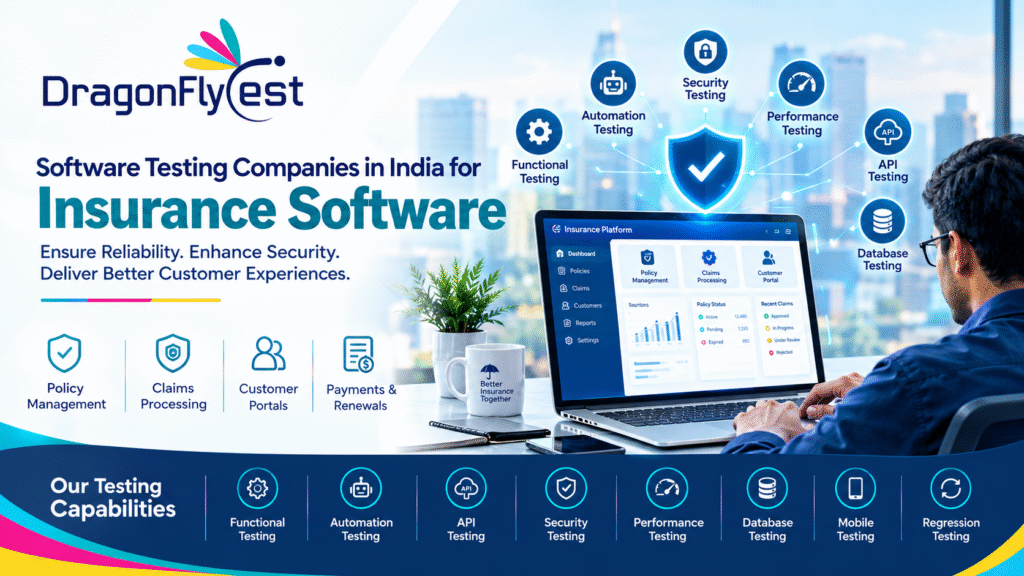
A specialized insurance QA and testing partner can help insurers, brokers, TPAs, insurtech companies, and technology providers validate applications across functional, integration, automation, performance, security, database, API, mobile, usability, and regression testing.
For example, DragonFlyTest’s insurance testing practice specifically covers areas such as call-center applications, policy servicing, claims, direct channels, reports, and business intelligence. Its insurance page also highlights functional testing, digital assurance, modernization, application security, and performance as important areas for insurance technology.
What Is Insurance Software Testing?
Insurance software testing is the process of validating insurance applications and platforms to ensure that they perform according to business requirements, technical specifications, security expectations, and applicable regulatory requirements.
Unlike generic application testing, insurance QA needs to understand business workflows such as:
- Customer onboarding
- Insurance quotation
- Proposal creation
- Underwriting
- Policy issuance
- Premium calculation
- Policy servicing
- Renewals
- Endorsements
- Cancellations
- Claims registration
- Claims processing
- Claim settlement
- Agent management
- Broker management
- Commission calculation
- Payments and refunds
- Document generation
- Notifications
- Reports and analytics
A defect in an insurance application can potentially affect financial transactions, customer experience, policy information, claims processing, or regulatory reporting.
Therefore, insurance testing normally combines domain knowledge with modern software testing technologies.
Software Testing Companies in India for Insurance Software
India has a large ecosystem of IT services, quality engineering, software testing, automation, and digital transformation companies. When selecting an insurance QA partner, insurers should evaluate domain expertise, testing capabilities, automation maturity, security experience, technology coverage, integration capabilities, and the ability to work with complex legacy and modern systems.
The following is an illustrative list of companies that offer software engineering, quality engineering, testing, or insurance technology capabilities. It is not a market ranking or claim that the companies are ranked by performance.
1. Tata Consultancy Services (TCS)
TCS provides quality engineering and application testing services and also has dedicated insurance technology capabilities. Its insurance portfolio includes solutions covering life insurance, property and casualty insurance, health insurance, policy servicing, underwriting, claims, and related insurance operations. TCS has also documented insurance engagements involving automated testing, test management, defect management, and CI/CD.
2. Infosys
Infosys provides technology and application services for insurers, including testing and quality assurance. Its work with the Fadata INSIS insurance platform includes application regression testing, performance testing, functional/unit testing, BDD frameworks, and Selenium-based testing.
3. Dragonfly Testing Solutions / DragonFlyTest
Dragonfly Testing Solutions, operating as DragonFlyTest, is an India-based software testing and quality engineering company with dedicated insurance testing services.
DragonFlyTest’s insurance practice addresses areas including:
- Call-center applications
- Policy servicing
- Claims
- Direct insurance channels
- Reports and business intelligence
- Functional testing
- Automation testing
- Performance testing
- Security testing
- API testing
- Database testing
- ETL testing
- Mobile application testing
- Regression testing
- Test advisory
- TCoE services
The company’s insurance testing page states that its approach is intended to support insurers through digital transformation and help improve application reliability, customer experience, operational efficiency, and modernization.
DragonFlyTest also lists insurance among its dedicated industry areas and offers functional, automation, mobile, API, performance, security, accessibility, usability, IoT, ETL, database, and other testing capabilities.
For insurers looking for an insurance software testing company in India, DragonFlyTest can therefore be considered for domain-focused QA and broader software testing requirements.
4. Wipro
Wipro provides quality engineering and testing advisory capabilities covering testing transformation, QA strategy, Agile, DevOps, AI, predictive analytics, and other modern testing approaches.
5. Other Specialist and Enterprise Testing Providers
Depending on project requirements, organizations may also evaluate other Indian and global providers with India delivery capabilities, including companies specializing in:
- Quality engineering
- Insurance platform implementation
- Guidewire testing
- Core insurance application testing
- Digital assurance
- Automation testing
- Performance engineering
- Security testing
- Data and analytics testing
- Cloud testing
The important point is that the right provider should be selected based on the insurer’s specific technology stack, business processes, regulatory requirements, project size, and testing objectives rather than company name alone.
Why Insurance Applications Require Specialized QA
Insurance software has several characteristics that make testing particularly important.
1. Complex Business Rules
Insurance products contain numerous rules involving:
- Age
- Risk
- Coverage
- Premium
- Deductibles
- Policy terms
- Riders
- Discounts
- Taxes
- Eligibility
- Claims
- Renewals
- Endorsements
A small defect in a business rule can produce incorrect calculations or policy outcomes.
2. Sensitive Customer Data
Insurance platforms can contain personal, financial, health, identity, and policy information.
Testing therefore needs to consider:
- Authentication
- Authorization
- Encryption
- Session management
- Data masking
- Secure APIs
- Vulnerability management
- Audit trails
- Access controls
IRDAI has issued information and cybersecurity requirements for insurers and has also extended such guidelines to insurance intermediaries. Its published framework addresses security across areas such as data, applications, operating systems, networks, and security audit.
3. Large Integration Ecosystems
Insurance applications rarely operate independently.
They may integrate with:
- Payment gateways
- Banking systems
- Government services
- Identity services
- CRM
- Email/SMS systems
- Document-generation platforms
- Medical databases
- Vehicle databases
- Agent portals
- Broker platforms
- Reinsurance systems
- Analytics platforms
API and integration testing are therefore critical.
4. Legacy + Modern Technology
Many insurers operate a combination of:
- Mainframe systems
- Legacy databases
- Web applications
- Mobile applications
- Microservices
- Cloud platforms
- APIs
- Third-party applications
Testing must verify that modern components work correctly with existing systems.
Major Types of Insurance Software Testing
Functional Testing
Functional testing validates whether insurance applications perform according to business requirements.
Examples include:
- Login
- Customer registration
- Quote generation
- Proposal creation
- Policy issuance
- Premium calculation
- Policy renewal
- Endorsement
- Cancellation
- Claims registration
- Claims approval
- Claims settlement
- Refunds
- Commission calculation
DragonFlyTest specifically identifies functional testing as a key part of its insurance testing approach.
Insurance Automation Testing
Automation testing is especially valuable for insurance applications because many business workflows must be repeatedly validated during releases.
Automation can cover:
- Login
- Quote generation
- Policy creation
- Premium calculations
- Policy renewal
- Claims workflows
- Customer registration
- Regression suites
- API validation
- Database validation
- Document validation
Automation can help reduce repetitive manual effort and provide faster feedback during development and release cycles.
Regression Testing
Insurance applications frequently receive changes to products, pricing, workflows, regulations, integrations, and user interfaces.
Regression testing verifies that new changes have not broken existing functionality.
A mature regression suite can cover:
Customer → Quote → Proposal → Underwriting → Policy → Payment → Servicing → Claim → Settlement → Renewal
API Testing for Insurance Applications
Modern insurance ecosystems depend heavily on APIs.
API testing should validate:
- Request/response structure
- Authentication
- Authorization
- HTTP status codes
- Business rules
- Error handling
- Data validation
- Response time
- Security
- Integration behavior
Common technologies include:
- Postman
- Newman
- REST Assured
- SoapUI
- ReadyAPI
- Karate
- Swagger/OpenAPI
- Java
- Python
- JavaScript/TypeScript
API automation can become particularly useful when the same insurance business services are consumed by web portals, mobile applications, agents, brokers, and third-party applications.
Database Testing
Insurance applications depend heavily on accurate data.
Database testing validates:
- Customer records
- Policy records
- Premium information
- Claim records
- Payment information
- Transaction history
- Agent information
- Commission data
- Audit records
Common database technologies and tools include:
- Oracle
- Microsoft SQL Server
- PostgreSQL
- MySQL
- DB2
- SQL
- PL/SQL
- JDBC
- Database automation frameworks
- ETL testing tools
DragonFlyTest also provides database testing, ETL testing, and database automation capabilities as part of its broader testing portfolio.
Insurance Performance Testing
Performance is critical when large numbers of customers access an insurance platform simultaneously.
Performance testing can include:
Load Testing
Measures application behavior under expected user loads.
Stress Testing
Pushes the system beyond expected capacity to identify breaking points.
Volume Testing
Validates application behavior with large amounts of data.
Scalability Testing
Determines how effectively the application handles increasing demand.
Endurance Testing
Checks application stability during extended workloads.
Popular tools include:
- Apache JMeter
- Micro Focus LoadRunner
- Gatling
- k6
- BlazeMeter
- NeoLoad
Performance testing can help identify database bottlenecks, API latency, server limitations, inefficient queries, and infrastructure constraints.
DragonFlyTest’s performance testing services include load testing, stress testing, and capacity planning.
Security Testing for Insurance Software
Security testing should be a major component of insurance QA because insurance systems process sensitive customer information.
Security testing can cover:
- Vulnerability assessment
- Penetration testing
- Authentication testing
- Authorization testing
- API security
- Session security
- Encryption validation
- Access-control testing
- Data exposure
- SQL injection
- Cross-site scripting
- CSRF
- Security headers
- File-upload vulnerabilities
Common tools include:
- Burp Suite
- OWASP ZAP
- Nessus
- Qualys
- SonarQube
- SAST tools
- DAST tools
- SCA tools
IRDAI’s cybersecurity framework includes requirements around vulnerability assessment and penetration testing. An IRDAI circular also specifies periodic VA/PT expectations for infrastructure and applications, including additional testing when changes occur.
Security testing requirements should always be mapped to the applicable current regulatory and organizational requirements for the particular insurance product and deployment.
Mobile Application Testing
Insurance customers increasingly interact through mobile applications.
Mobile testing should cover:
- Android
- iOS
- Different screen sizes
- Network changes
- Notifications
- Biometric authentication
- Camera/document upload
- GPS where applicable
- Payment workflows
- Session handling
- Offline/poor-network behavior
- App performance
- Security
Common tools include:
- Appium
- Espresso
- XCUITest
- BrowserStack
- Sauce Labs
- Firebase Test Lab
Test Automation Technologies for Insurance QA
A modern insurance QA ecosystem can include a wide range of technologies.
Web Automation
- Selenium
- Playwright
- Cypress
- WebdriverIO
- UFT
Mobile Automation
- Appium
- Espresso
- XCUITest
API Automation
- REST Assured
- Postman/Newman
- SoapUI/ReadyAPI
- Karate
BDD
- Cucumber
- SpecFlow
- JBehave
Test Frameworks
- TestNG
- JUnit
- PyTest
- NUnit
Performance
- JMeter
- LoadRunner
- Gatling
- k6
- NeoLoad
Security
- Burp Suite
- OWASP ZAP
- Nessus
- Qualys
- SAST/DAST/SCA platforms
Database and Data
- SQL
- Oracle
- SQL Server
- PostgreSQL
- MySQL
- DB2
- ETL validation tools
- Data comparison frameworks
CI/CD
- Jenkins
- GitHub Actions
- GitLab CI/CD
- Azure DevOps
- Bamboo
Build and Dependency Management
- Maven
- Gradle
- npm
- Yarn
Cloud and Infrastructure
- AWS
- Microsoft Azure
- Google Cloud
- Docker
- Kubernetes
Insurance Platforms
Depending on the project, testing teams may encounter platforms and technologies such as:
- Guidewire
- Duck Creek
- Majesco
- INSIS
- Custom policy administration systems
- Legacy/mainframe insurance systems
- Microservices-based insurance platforms
Technology selection should be based on the application architecture rather than attempting to use every available testing tool.
QA Testing Process for Insurance Applications: Step-by-Step
A structured QA process helps insurers control quality from requirements through production.
Step 1: Understand the Insurance Business
The first step is domain understanding.
The QA team studies:
- Product requirements
- Policy rules
- Premium rules
- Underwriting rules
- Claims processes
- Payment workflows
- Customer journeys
- Regulatory requirements
- Integration requirements
Testers should understand what the application is expected to do before designing test cases.
Step 2: Requirement Analysis
QA teams analyze functional and non-functional requirements.
They identify:
- Testable requirements
- Business rules
- Dependencies
- Integration points
- Data requirements
- Security requirements
- Performance requirements
- Regulatory considerations
Ambiguous requirements should be identified before implementation progresses too far.
Step 3: Define the Test Strategy
The QA team prepares the overall test strategy.
This normally defines:
- Testing scope
- Testing types
- Environments
- Test data
- Automation strategy
- Tools
- Resources
- Entry criteria
- Exit criteria
- Defect process
- Reporting
- Risks
Step 4: Prepare Test Scenarios
Test scenarios are created around actual insurance journeys.
For example:
Customer Registration → Quote → Proposal → Underwriting → Payment → Policy Issuance
Another scenario may be:
Claim Registration → Document Upload → Claim Validation → Assessment → Approval → Settlement
Step 5: Create Detailed Test Cases
Detailed test cases should cover positive, negative, boundary, exception, and integration conditions.
Examples:
- Valid policy creation
- Invalid customer information
- Invalid premium
- Expired policy
- Duplicate policy
- Failed payment
- Partial payment
- Invalid claim document
- Duplicate claim
- Unauthorized policy modification
- Invalid API request
Step 6: Prepare Test Data
Insurance QA requires carefully designed test data.
Data can include:
- Customer profiles
- Policy information
- Premium values
- Claim records
- Payment data
- Agent data
- Product configurations
- Dates
- Renewal information
Sensitive production data should be appropriately masked or anonymized according to organizational security requirements.
Step 7: Test Environment Setup
The QA environment should represent important characteristics of production.
It may include:
- Application servers
- Databases
- APIs
- Payment gateways
- External integrations
- Mobile devices
- Cloud infrastructure
- Test automation frameworks
Environment stability is important because unstable environments can produce misleading test results.
Step 8: Functional Testing
Testers execute the core insurance business workflows.
This validates whether the application behaves according to the defined requirements.
Step 9: Integration and API Testing
QA validates communication between:
- Policy system
- Claims system
- Payment gateway
- CRM
- Mobile application
- Customer portal
- Third-party services
- Databases
- Analytics systems
Step 10: Automation Testing
Stable and repeatable test cases are automated.
Automation candidates typically include:
- Regression
- Smoke testing
- API testing
- Data validation
- Critical business workflows
- Cross-browser testing
Automation frameworks can then be connected to CI/CD pipelines.
Step 11: Database and Data Validation
QA compares application results against database records and expected business outcomes.
For example:
Premium entered → Premium calculated → Payment processed → Policy generated → Database updated
Every stage should maintain data consistency.
Step 12: Performance Testing
The team simulates realistic workloads.
Important scenarios may include:
- Open-enrollment campaigns
- Renewal periods
- High claim volumes
- Large customer logins
- Quote generation peaks
- Payment traffic
- Batch processing
The goal is to understand application behavior under expected and peak conditions.
Step 13: Security Testing
Security testing validates whether unauthorized users can access protected functions or data.
Testing should include application, API, database, infrastructure, and authentication layers as appropriate.
Step 14: Defect Management
Defects are logged with:
- Severity
- Priority
- Steps to reproduce
- Expected result
- Actual result
- Screenshots/logs
- Environment
- Build/version
- Business impact
Tools may include:
- Jira
- Azure DevOps
- ALM/Quality Center
- Bugzilla
- ServiceNow
Step 15: Regression Testing
After defects are fixed or new functionality is introduced, regression testing is performed.
Automated regression suites can significantly accelerate repeated validation.
Step 16: User Acceptance Testing
Business stakeholders validate whether the application satisfies actual insurance processes.
UAT may involve:
- Product owners
- Underwriters
- Claims teams
- Operations teams
- Agents
- Business analysts
- Compliance teams
Step 17: Release Validation
Before production deployment, QA evaluates:
- Critical defects
- Test coverage
- Regression results
- Performance results
- Security status
- Integration status
- Business acceptance
- Release risks
Step 18: Production Monitoring
QA does not necessarily stop after deployment.
Production quality can be supported through:
- Application monitoring
- API monitoring
- Error monitoring
- Performance monitoring
- Transaction monitoring
- Customer feedback
- Production incident analysis
Continuous feedback can then be incorporated into subsequent testing cycles.
How Automation Improves Insurance QA
Insurance applications often have thousands of combinations of products, customers, policies, dates, premiums, claims, and transactions.
Manual testing alone can become difficult to scale.
Automation can help organizations:
- Execute regression suites faster
- Validate repetitive workflows
- Run tests more frequently
- Reduce manual repetition
- Increase test coverage
- Validate APIs
- Compare database results
- Support CI/CD
- Generate reports
- Detect defects earlier
The goal should not be to automate every test case. Instead, QA teams should identify the scenarios where automation provides repeatable business value.
Why Choose DragonFlyTest for Insurance Software Testing?
DragonFlyTest provides insurance-focused testing services as well as a broad software quality engineering portfolio.
Its insurance testing practice addresses policy servicing, claims, call-center applications, direct channels, reports, and business intelligence.
Its broader testing capabilities include:
- Functional Testing
- Manual Testing
- Automation Testing
- Mobile Testing
- Regression Testing
- API Testing
- Performance Testing
- Security Testing
- Accessibility Testing
- Usability Testing
- Database Testing
- ETL Testing
- IoT Testing
- Test Advisory
- TCoE Setup
- Tosca
- RPA
DragonFlyTest also develops automation solutions including database automation, PDF automation, EDI automation, and other testing accelerators.
For insurance applications specifically, this combination can be useful because testing frequently crosses multiple layers: UI, API, database, documents, integrations, business rules, performance, and security.
Insurance QA Testing Checklist
Before releasing an insurance application, QA teams can use a checklist such as:
Functional
- Customer registration
- Login
- Quote
- Proposal
- Underwriting
- Policy issuance
- Renewal
- Endorsement
- Cancellation
- Claims
- Settlement
- Payments
- Refunds
Integration
- APIs
- Payment gateways
- CRM
- Third-party services
- Agent portals
- Broker portals
- Mobile applications
- External databases
Data
- Database validation
- Data integrity
- Data migration
- ETL validation
- Data reconciliation
- Data masking
Automation
- Smoke suite
- Regression suite
- API automation
- UI automation
- Database automation
- CI/CD integration
Performance
- Load
- Stress
- Volume
- Endurance
- Scalability
- Capacity
Security
- Authentication
- Authorization
- Encryption
- API security
- Vulnerability testing
- Penetration testing
- Session security
- Access controls
Mobile
- Android
- iOS
- Devices
- Network conditions
- Notifications
- App security
- Performance
Frequently Asked Questions
1. What are software testing companies in India for insurance software?
Software testing companies in India for insurance software provide QA and testing services for insurance applications such as policy administration, claims, underwriting, customer portals, mobile applications, payment systems, APIs, databases, and reporting platforms.
2. Why is insurance domain expertise important in software testing?
Insurance applications contain complex business rules around policies, premiums, underwriting, claims, renewals, endorsements, payments, and customer data. Domain knowledge helps testers create meaningful scenarios rather than testing only the user interface.
3. What types of insurance applications can be tested?
Testing can cover:
- Life insurance
- Health insurance
- Motor insurance
- Property insurance
- Travel insurance
- Commercial insurance
- Policy administration systems
- Claims platforms
- Agent portals
- Broker portals
- Customer portals
- Mobile applications
4. Which tools are used for insurance automation testing?
Common technologies include Selenium, Playwright, Cypress, Appium, REST Assured, Postman, SoapUI, Cucumber, TestNG, JUnit, JMeter, LoadRunner, Jenkins, GitLab, GitHub Actions, Azure DevOps, SQL, Oracle, SQL Server, PostgreSQL, and security testing tools.
5. Is API testing important for insurance applications?
Yes. Modern insurance ecosystems frequently depend on APIs connecting customer applications, policy systems, claims systems, payment services, CRM platforms, and external systems.
6. Is database testing required for insurance software?
Yes. Database validation can help ensure that customer, policy, premium, payment, claims, and transaction information remains accurate and consistent.
7. How does performance testing help insurers?
Performance testing helps identify application behavior under expected and peak workloads. This can be particularly important during high-volume activities such as renewals, campaigns, claims processing, or large customer transactions.
8. How can automation help insurance companies?
Automation can accelerate repeatable regression testing, API validation, database checks, smoke testing, and critical business workflows while supporting faster release cycles.
9. Does DragonFlyTest provide insurance software testing?
Yes. DragonFlyTest has a dedicated insurance testing practice covering areas such as call-center applications, policy servicing, claims, direct channels, reports, and business intelligence.
Conclusion
The growth of digital insurance is increasing the importance of reliable, secure, scalable, and well-tested software.
For insurers and insurtech companies, quality assurance needs to go beyond basic functional testing. A mature insurance QA strategy should combine functional testing, automation testing, API testing, database testing, performance testing, security testing, mobile testing, integration testing, regression testing, data validation, and continuous testing.
When evaluating software testing companies in India for insurance software, organizations should consider insurance domain experience, automation capabilities, technology expertise, security maturity, performance engineering, integration testing, data testing, and the ability to support both legacy and modern architectures.
DragonFlyTest is one option for organizations looking for an India-based testing partner with a dedicated insurance testing practice and a broader portfolio covering automation, API, mobile, performance, security, database, ETL, and other quality engineering services.
The ultimate objective is simple:
Test earlier. Automate intelligently. Protect customer data. Validate every critical insurance journey. Deliver better digital insurance experiences.
Looking for Insurance Software Testing Services in India?
DragonFlyTest provides insurance-focused QA and software testing services designed to help organizations validate critical insurance applications and digital journeys.
🌐 dragonflytest.com
📧 [email protected]
📞 +91 8019169474

 USA
USA