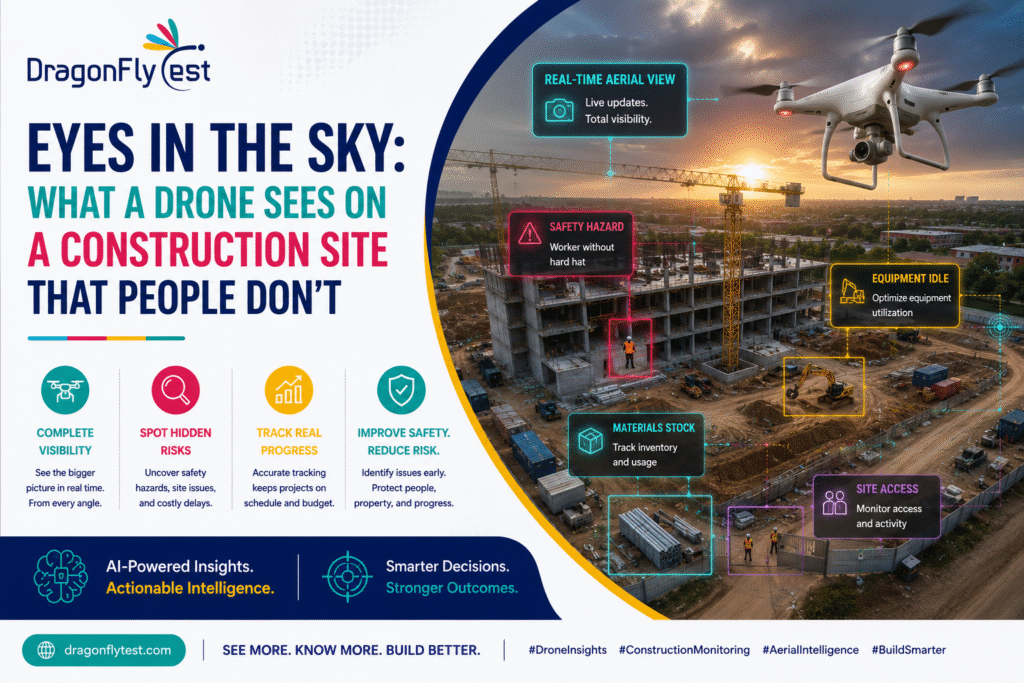
Construction site safety has always depended heavily on regular inspections, supervisor walkthroughs, and the experience of safety teams. But even the most experienced safety professional cannot be everywhere at once. On large construction sites, workers may be spread across multiple floors, scaffolding areas, open structures, and restricted zones.
This is where AI-powered PPE compliance is becoming increasingly valuable.
By combining drones, computer vision, and artificial intelligence, construction companies can monitor personal protective equipment (PPE) compliance across large areas and identify potential safety violations faster. Instead of relying only on manual inspections, safety teams can use AI-generated insights to focus their attention exactly where it is needed.
Table of Contents
ToggleWhy AI-Powered PPE Compliance Is Becoming Important
Anyone who has spent time on a construction site understands the challenges of maintaining safety compliance. A supervisor may walk through a site several times a day, but it is impossible to continuously monitor every worker.
A worker may remove a helmet for a few minutes, forget to wear a safety vest, or enter a high-risk area without proper footwear. If that moment is not noticed during a manual inspection, the safety violation may go undocumented.
This is where AI-powered PPE compliance can provide an additional layer of monitoring.
A drone equipped with high-resolution cameras can capture footage from elevated positions and cover areas that may be difficult for safety personnel to inspect manually. AI-based computer vision models can then analyse the footage and identify workers while checking for PPE such as:
- Safety helmets
- High-visibility safety vests
- Protective footwear
- Other required safety equipment
The goal is not to replace safety professionals but to provide them with an additional, consistent set of eyes.
A Real-World Look at AI-Based PPE Detection
During a recent site safety review, drone footage from a construction project was analysed using AI-based computer vision.
In one frame, the system identified seven workers in a rebar zone near a crane base.
Persons Detected: 7 | Helmet Compliance: 4/7 | Vest Compliance: 3/7 | Safety Footwear: 1/7
The numbers immediately highlighted a potential safety concern.
Only one worker was detected with protective footwear that the AI model was sufficiently confident to classify as compliant. On a rebar-heavy construction floor, this type of information can be valuable because footwear compliance may be difficult to verify during a quick ground-level inspection.
The AI system does not necessarily make the final safety decision. Instead, it highlights the area so that a safety professional can review the footage and take appropriate action.
That is one of the biggest advantages of AI-powered PPE compliance: helping safety teams identify potential problems that might otherwise go unnoticed.
Larger Workforces Create Larger Safety Blind Spots
In another example, a wider drone view captured ten workers across a scaffolding and open-rebar section.
Persons Detected: 10 | Helmet Compliance: 5/10 | Vest Compliance: 0/10 | Safety Footwear: 0/10
At first glance, the results appear concerning. However, AI detection results should always be interpreted carefully.
A worker may be partially hidden, standing in a shadow, or viewed from an angle that makes PPE difficult to detect. A safety vest may also be covered by another garment or may not be clearly visible from the drone’s position.
This is why AI-generated alerts should not automatically be treated as confirmed safety violations.
Instead, they should act as intelligent alerts that direct the safety team’s attention to a specific location or worker.
The process becomes:
AI detects → System generates alert → Human reviews → Safety team takes action
This combination of AI and human expertise can make safety monitoring more efficient without removing human judgment from the process.
Confidence Scores Make AI Safety Monitoring More Practical
One of the most useful aspects of modern AI-based PPE detection systems is confidence scoring.
Consider another example involving five workers.
Persons Detected: 5 | Helmet Compliance: 5/5 | Vest Compliance: 3/5 | Safety Footwear: 0/5
In this case, all five workers were detected wearing helmets. However, the system also identified one worker with a No_Vest classification.
This type of classification is different from a situation where the AI simply cannot determine whether a worker is wearing a vest.
For example:
- Low confidence: The AI cannot clearly see the PPE.
- No detection: The PPE may not be visible from the camera angle.
- High-confidence violation: The system detects that the required PPE is likely missing.
This distinction is important because it allows safety teams to prioritise alerts instead of treating every AI detection as an emergency.
AI-Powered PPE Compliance Goes Beyond Helmets and Vests
Once a drone is collecting visual data across a construction site, the same AI infrastructure can potentially be used for more than PPE monitoring.
Depending on the capabilities of the computer vision system, construction companies can explore applications such as:
- Detecting workers near unprotected edges
- Monitoring restricted or hazardous zones
- Identifying unsafe worker proximity to machinery
- Monitoring scaffolding areas
- Detecting potential obstructions
- Identifying unsafe material storage
- Monitoring site access
- Supporting post-incident investigation
- Creating visual records of site conditions
This means AI-powered PPE compliance can become part of a broader AI-based construction safety monitoring ecosystem.
For example, if an incident occurs, recorded drone footage can potentially help safety teams understand what happened before the event. Instead of relying entirely on memory or manual reports, teams may have visual information that can be reviewed later.
AI Should Support Safety Teams, Not Replace Them
One of the biggest mistakes companies can make is treating AI detection results as absolute truth.
A confidence score of 0.34 for helmet detection does not mean the worker definitely has no helmet. It simply means the AI model is not sufficiently confident in what it sees.
Environmental conditions can affect AI performance, including:
- Poor lighting
- Shadows
- Camera angle
- Distance from the worker
- Occlusion
- Dust
- Weather conditions
- Low-resolution footage
- Workers partially hidden by equipment
For this reason, the most effective AI-powered PPE compliance systems should work alongside experienced safety professionals.
The AI provides the monitoring capability.
The safety professional provides the context and decision-making.
Together, they can create a more effective safety process.
The Real Value of AI-Powered PPE Compliance
The biggest benefit is not necessarily perfect detection.
The real value is visibility.
On a large construction site, safety teams may not have the resources to continuously monitor every worker and every location. AI-powered video analytics can help identify potential issues across large areas and bring them to the attention of the right people.
Instead of asking:
“Did someone notice the safety violation?”
The question becomes:
“Did the AI system detect a potential violation, and did the safety team review it?”
That shift can help organisations move from occasional safety inspections toward more continuous and proactive safety monitoring.
Should Construction Companies Consider AI-Powered PPE Compliance?
For construction projects with large workforces, multiple floors, extensive scaffolding, or difficult-to-access areas, AI-powered PPE monitoring is worth exploring.
However, companies should not expect AI to replace existing safety processes.
A practical approach is to start with a pilot project. Run AI-based drone monitoring alongside existing safety inspections for several weeks. Compare the AI alerts with the observations made by safety professionals.
This can help answer important questions:
- How accurate are the PPE detections?
- Which types of violations are detected most effectively?
- How many false alerts are generated?
- Does the system identify issues that manual inspections miss?
- How quickly can safety teams respond to alerts?
- Can the technology improve overall safety compliance?
The answers will depend on the construction environment, camera quality, AI model, and implementation strategy.
Final Thoughts
AI-powered PPE compliance is not about removing humans from construction safety. It is about giving safety teams better visibility across increasingly complex worksites.
Drones can provide a broader view.
AI can analyse the footage.
Computer vision can identify potential PPE violations.
And safety professionals can review the information and make the final decisions.
When these technologies are used together, construction companies can move toward a more proactive approach to workplace safety—one where potential risks are identified earlier, safety teams can respond faster, and compliance monitoring becomes more consistent.
The future of construction safety may not be about choosing between humans and AI. It may be about combining the strengths of both.

 USA
USA