
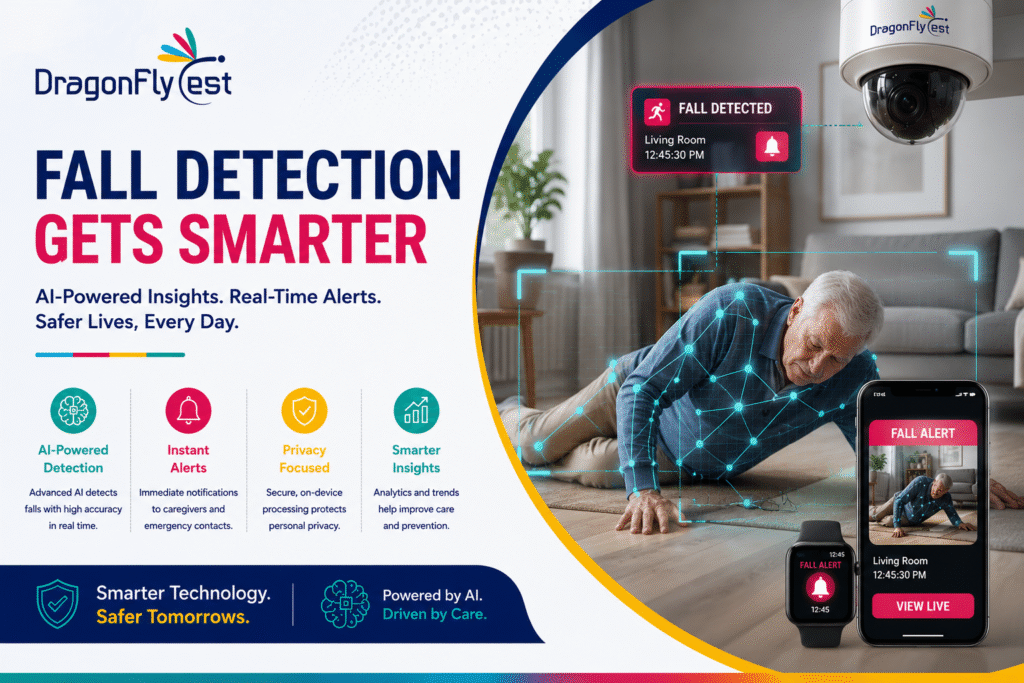
A few years ago, if an elderly parent living alone fell at home, there were only a few ways anyone could find out. They had to call for help, press an emergency button, or someone had to notice that something was wrong.
The problem is that falls happen in seconds, while help may take minutes or even hours to arrive.
This is where AI fall detection is making a real difference. Using artificial intelligence and computer vision, modern monitoring systems can identify when a person appears to fall, analyze what happens afterward, and send an alert when the situation may require immediate attention.
The technology is moving beyond traditional emergency buttons and creating a smarter safety layer for homes, hospitals, assisted living facilities, and other environments where people may need additional protection.
Table of Contents
ToggleWhy AI Fall Detection Matters
Falls are a major safety concern for elderly people and patients recovering from illness or surgery. A person who falls and receives help immediately may have a very different outcome from someone who remains on the floor unnoticed for hours.
The same challenge exists in healthcare environments.
A patient may fall from a bed when a nurse is attending to another patient. An elderly resident may collapse in a hallway between routine checks. Someone may lose their balance in a bathroom where continuous human supervision is not practical.
The common problem is simple: human attention has limits.
A caregiver cannot watch every room at the same time. A nurse cannot monitor every patient every second. Even when security cameras are installed, someone would still need to watch the video feeds continuously to identify an emergency.
This is where AI-powered monitoring can add another layer of protection.
Instead of simply recording video, an AI system can continuously analyze what is happening and identify patterns that may indicate a fall.
What Is AI Fall Detection?
At its core, AI fall detection uses computer vision and artificial intelligence to analyze human movement, posture, and behavior.
The system isn’t simply searching for a person lying on the floor. That approach would create too many false alarms because people may sit on the floor, exercise, stretch, or pick something up.
Instead, intelligent fall detection systems typically analyze several factors together.
Body Orientation
The system examines whether a person changes from an upright position to a horizontal or unusual posture.
Speed of Movement
A sudden transition from standing to lying down may be more consistent with a fall than a slow, controlled movement.
Post-Fall Behavior
The system can also examine what happens immediately after the suspected fall. Does the person get up? Do they continue moving? Or do they remain still?
These signals can be combined to generate a confidence score for a potential fall event.
For example, an AI system may identify a person with a bounding box and label the event as “fallen” with a particular confidence level.
A lower confidence score may indicate that the system is uncertain. A higher confidence score, combined with prolonged immobility, may represent a more urgent situation.
This combination of fall detection and post-fall analysis is what makes modern systems more useful than simply identifying a person on the ground.
Why Stillness Tracking Is So Important
Detecting the fall is only the beginning.
The next question is:
What happened after the person fell?
Imagine two different situations.
In the first, someone trips, sits on the floor, realizes they are fine, and stands up within a few seconds.
In the second, someone falls heavily and remains motionless for several minutes.
Both events may initially look similar to an AI system. But the outcome is clearly different.
This is why advanced AI fall detection systems can monitor post-fall stillness.
An immobility timer can track how long a person remains in the same position after a suspected fall. The system can then use this information to determine whether an event should remain a background notification or become an urgent alert.
For example:
- Fall detected + person gets up quickly: Low concern
- Fall detected + short period of stillness: Monitor
- Fall detected + prolonged immobility: Escalate alert
- High-confidence fall + extended immobility: Immediate attention may be required
This layered approach can significantly reduce unnecessary alerts while ensuring potentially serious situations receive attention.
Where AI Fall Detection Can Be Used
AI-powered fall detection is not limited to hospitals. The technology can be useful in several environments.
1. Elderly Care at Home
For families living away from elderly parents, AI monitoring can provide additional peace of mind.
Instead of making constant calls or relying entirely on emergency buttons, family members can receive an alert when the system identifies a potential fall or prolonged immobility.
The goal is not to replace human interaction. It is to make sure that a potentially serious situation does not go unnoticed.
2. Assisted Living Facilities
Care teams often have to manage multiple residents at the same time.
AI monitoring can provide an additional safety layer in common areas, corridors, and other locations where a fall might otherwise go unnoticed until the next scheduled check.
The technology doesn’t replace caregivers. Instead, it helps direct their attention toward situations that may require immediate action.
3. Hospitals and Rehabilitation Centers
Patients recovering from surgery or taking certain medications may have an increased risk of falling.
AI-powered monitoring can help staff identify potential incidents more quickly, particularly when a patient falls in an area that is not continuously monitored by medical staff.
4. Offices and Commercial Spaces
Falls can also happen in offices, shopping environments, reception areas, and other public spaces.
Real-time AI analytics can act as an additional safety mechanism, helping staff respond quickly when someone appears to collapse or fall.
The Limitations of AI Fall Detection
While the technology is promising, it is important to understand its limitations.
AI systems do not interpret the world exactly like humans do. Several factors can affect detection accuracy.
Lighting Conditions
Poor lighting, strong shadows, or sudden changes in illumination can make it difficult for computer vision systems to interpret a person’s posture correctly.
Occlusion
Furniture, walls, beds, and other objects can partially block the camera’s view.
If a person falls behind a desk or couch, the AI may only see part of the body, making accurate detection more difficult.
False Positives
A person exercising on the floor, reaching for something, or playing with a pet could temporarily resemble a fall.
This is why reliable systems should analyze movement over time rather than reacting to a single video frame.
Privacy
Privacy is one of the most important considerations when deploying AI-based monitoring.
People should understand how the technology works, what data is collected, and how long information is retained.
Where possible, privacy-focused approaches may include local video processing, edge AI, and skeletal or pose-based analysis rather than continuously storing raw video footage.
The objective should always be to improve safety while maintaining the dignity and privacy of the person being monitored.
What Makes a Good AI Fall Detection System?
The systems that provide the most practical value are not necessarily the ones that generate the most alerts.
They are the ones that generate useful alerts.
A good system should ideally provide context around an event rather than simply displaying:
“Fall Detected.”
A more useful alert might include information such as:
- Potential fall detected
- Person remains on the floor
- Immobility duration: 90 seconds
- Detection confidence: 0.81
- Location: Bedroom 2
This additional information allows caregivers, family members, or healthcare staff to understand the situation and determine how urgently they need to respond.
A good system should also escalate gradually.
A brief movement on the floor should not necessarily trigger an emergency response. But if a person remains motionless for an extended period, the alert level should increase.
This approach can help reduce alert fatigue and improve trust in the system.
The Future of AI-Powered Fall Detection
The future of this technology may go beyond detecting falls after they happen.
The next generation of AI analytics could focus more heavily on fall risk prediction.
For example, computer vision systems may analyze changes in walking patterns, balance, posture, or movement over time.
A gradual change in gait or walking speed could potentially indicate an increased risk of falling.
When combined with other technologies such as wearable sensors, health monitoring devices, and smart home systems, AI could eventually help caregivers identify potential risks before an actual fall occurs.
The focus could shift from:
“A person has fallen. What should we do?”
to:
“This person may be at increased risk of falling. How can we prevent it?”
That transition from reactive monitoring to proactive care could become one of the most valuable applications of AI in elderly care and healthcare.
The Bottom Line
AI fall detection is not about replacing caregivers, nurses, or family members.
It is about providing an additional layer of protection when human attention cannot be everywhere at once.
A camera alone can record what happened. AI analytics can help identify what may be happening in real time.
When someone falls, the difference between being noticed immediately and being discovered hours later can be significant. By combining computer vision, posture analysis, confidence scoring, and post-fall stillness tracking, AI-powered systems can help ensure that potential emergencies receive attention when it matters most.
The technology is not perfect, and it should never be treated as a replacement for human care. But when designed responsibly—with accuracy, privacy, and dignity in mind—AI fall detection can become a powerful tool for protecting elderly people, patients, and vulnerable individuals when the people who care about them cannot be physically present.

 USA
USA