
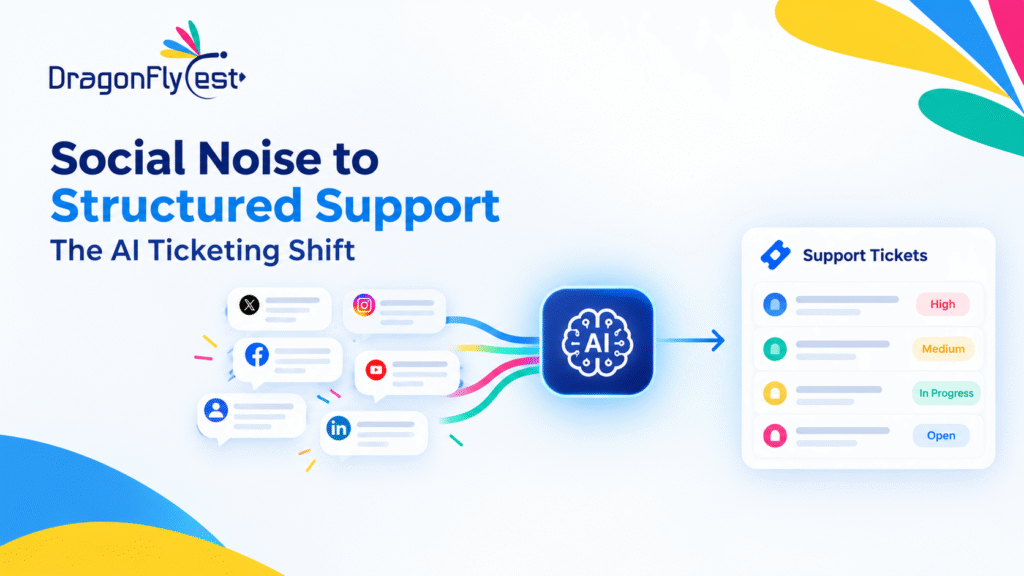
Open Twitter, Instagram, or Facebook on any given day and search for a well-known consumer brand’s handle. Chances are you’ll find someone publicly venting about a refund that never came, an order that went sideways, or an app that charged them twice. Consumer-facing companies across industries see this constantly — a frustrated comment, a tagged handle, and a public post that doubles as a support ticket whether the company wants it to or not.
This is the reality most consumer-facing companies live in now. Customers don’t always email support or open a help-desk form. Increasingly, they just post. A tweet, a comment under a brand’s Instagram post, a public reply to a company’s own announcement — these have quietly become one of the busiest support channels a business has, and unlike email, they’re visible to everyone watching. A slow or tone-deaf response doesn’t just annoy one customer; it becomes a public record of how the company handles problems.
That visibility is exactly why a growing number of companies are building AI ticketing platforms — systems that treat a public comment or mention the same way a traditional help desk treats an email, but faster, and without a human having to first notice it exists. This post walks through how a platform like that actually works, from the moment a customer posts a complaint to the moment a reply lands back in the same public thread.
The Problem With Support Living on Social Media
Before getting into how these platforms work, it’s worth being honest about why they’re needed. Social media wasn’t designed to be a support channel. There’s no structured form, no dropdown for “issue type,” no field for order ID. A customer just types what they’re feeling — “worst experience ever, I was charged and never got what I paid for” — and hits post. That single sentence, unstructured and emotional, is now something a support team has to somehow route, prioritize, and resolve.
For a company with a large user base, the volume alone is the first problem. Hundreds or thousands of mentions a day, scattered across multiple platforms, phrased in dozens of different ways, some of them urgent and some of them just noise. A support team manually scanning mentions and deciding what matters is never going to keep pace, and every minute spent scrolling through a feed looking for real complaints is a minute not spent actually resolving anything. This is the gap an AI-driven ticketing layer is built to close.
From Public Comment to Structured Ticket
The first job of the platform is deceptively simple to describe and genuinely hard to do well: take an unstructured social media post and turn it into a structured support ticket, automatically, the moment it appears. A customer complaint written as a comment or a tweet gets picked up by the platform, converted into a formal ticket with its own ID, and logged the same way a ticket submitted through a help desk form would be — except nobody had to fill out a form.
This matters because it puts social media complaints on equal footing with every other support channel. A company that treats email tickets seriously but treats social comments as an afterthought is, functionally, telling its most publicly vocal customers that they matter less than the quiet ones. Converting every flagged mention into a real ticket closes that gap and makes sure nothing gets lost in a feed that’s moving too fast for any one person to track.
Letting AI Read the Complaint the Way a Human Would
Once a ticket exists, the next step is understanding what it’s actually about — and this is where natural language processing does the heavy lifting. The AI reads the post the way an experienced support agent would: pulling out the core issue, the sentiment behind it, any relevant details like an order or account reference, and classifying what kind of problem this actually is.
A complaint about a double charge gets classified differently from a complaint about product quality, which gets classified differently again from a general app crash report. The AI doesn’t just look for keywords — it’s parsing intent and context, which is why it can tell the difference between “my refund never came” (a billing issue) and “I never even got a refund confirmation email, is that normal?” (potentially just a request for information, not necessarily a complaint at all). Getting this classification right is what makes everything downstream actually work; a misclassified ticket sent to the wrong team is often worse than a delay, because it has to be re-routed before anyone even starts working on it.
Routing to the Right Department and Person, Automatically
Classification feeds directly into assignment. Once the system knows what kind of issue this is, it routes the ticket to the concerned department — billing, operations, product support, technical support, whichever team actually owns that category of problem — and, where the platform is sophisticated enough, to a specific person within that team based on their current workload, expertise, or existing relationship with that ticket type.
This is a meaningful shift away from how social media complaints traditionally got handled, which was often a single social media manager trying to triage everything themselves, forwarding things internally by copy-pasting into Slack or email, and hoping the right person saw it in time. Automated routing removes that bottleneck entirely. The moment a ticket is classified, it’s already sitting in the right queue, in front of the right team, without a human having to manually hand it off.
Priority Isn’t Just About Volume — It’s About Risk
Not every complaint deserves the same urgency, and a good ticketing platform doesn’t treat them as if they do. Alongside classification and routing, the AI assigns a priority level based on a combination of factors: the severity of the issue described, the sentiment and emotional intensity of the post, whether the customer has a history of escalations, and — critically for social media — how public and visible the complaint already is.
A private-sounding billing question might get a standard priority. A public tweet with an angry tone, tagging the company directly, mentioning a safety concern, and already picking up replies from other frustrated users gets flagged as high priority almost immediately, because the reputational cost of a slow response is compounding in real time. This is one of the biggest differences between social ticketing and traditional support — the platform in prioritizing isn’t just answering “how bad is this problem for the customer,” it’s also weighing “how visible is this problem to everyone else watching.”
SLA Tracking That Doesn’t Rely on Someone Remembering
Every ticket, once created and prioritized, gets tied to a service-level agreement — a defined window within which the issue needs a first response and, separately, a resolution. This is where a lot of manually-run social support falls apart in practice: a team might genuinely intend to respond quickly, but without a system actively tracking the clock, tickets slip, especially during high-volume periods or over weekends.
An AI-driven platform handles this by continuously monitoring where every open ticket stands relative to its SLA deadline, and escalating automatically as that deadline approaches. A ticket sitting untouched as its SLA window closes doesn’t just quietly breach — it gets flagged, surfaced to a supervisor, or bumped in priority so it gets attention before the deadline is missed rather than after. Over time, this also generates the kind of operational data that matters for improving the whole system: average resolution time by issue type, how often SLAs are actually met, and where bottlenecks consistently show up. A department that consistently blows through its SLA on a specific ticket category is a signal that something structural needs fixing — staffing, process, or a genuinely difficult category of issue that needs a better internal solution.
Closing the Loop: Replying Where the Complaint Was Posted
Perhaps the most visible part of the entire system, from a customer’s perspective, is the final step: once an issue is resolved, or a response is ready, the reply gets posted directly as a comment on the original ticket — back on the same platform, in the same public thread where the complaint originated.
This closes the loop in a way that matters more on social media than almost anywhere else. A customer who complains by email expects a reply by email, privately. A customer who complains publicly on social media is, consciously or not, also asking to be seen responding to publicly. Replying in the same thread does double duty: it resolves the individual customer’s issue, and it demonstrates to everyone else reading that thread — including people who never had the problem themselves — that the company is actually paying attention and responding. A visibly responsive brand on social media builds a different kind of trust than one that only resolves things quietly behind the scenes.
Why This Approach Matters Beyond Just Speed
It would be easy to frame all of this purely as an efficiency story — faster classification, faster routing, faster replies. That’s true, but it undersells what’s actually changing. What this kind of platform really does is bring the same structure, accountability, and measurability that traditional support channels have always had, and apply it to a channel that used to run entirely on improvisation and whoever happened to be watching the mentions tab that day.
For a company operating at real scale — the kind that generates hundreds of social mentions daily across multiple platforms — that structure isn’t optional for much longer. Customers already expect a company’s app, website, and call center to be responsive. Social media is simply catching up to that same expectation, and the businesses that treat it with the same rigor as their formal support channels are the ones that end up looking, publicly, like they actually have their act together — because increasingly, that public thread is the only version of “customer support” a lot of onlookers ever see.

 USA
USA